When to Shear?
Straight cuts from thin to medium-gauge sheet, where a clean, heat-free edge with no distortion is required.
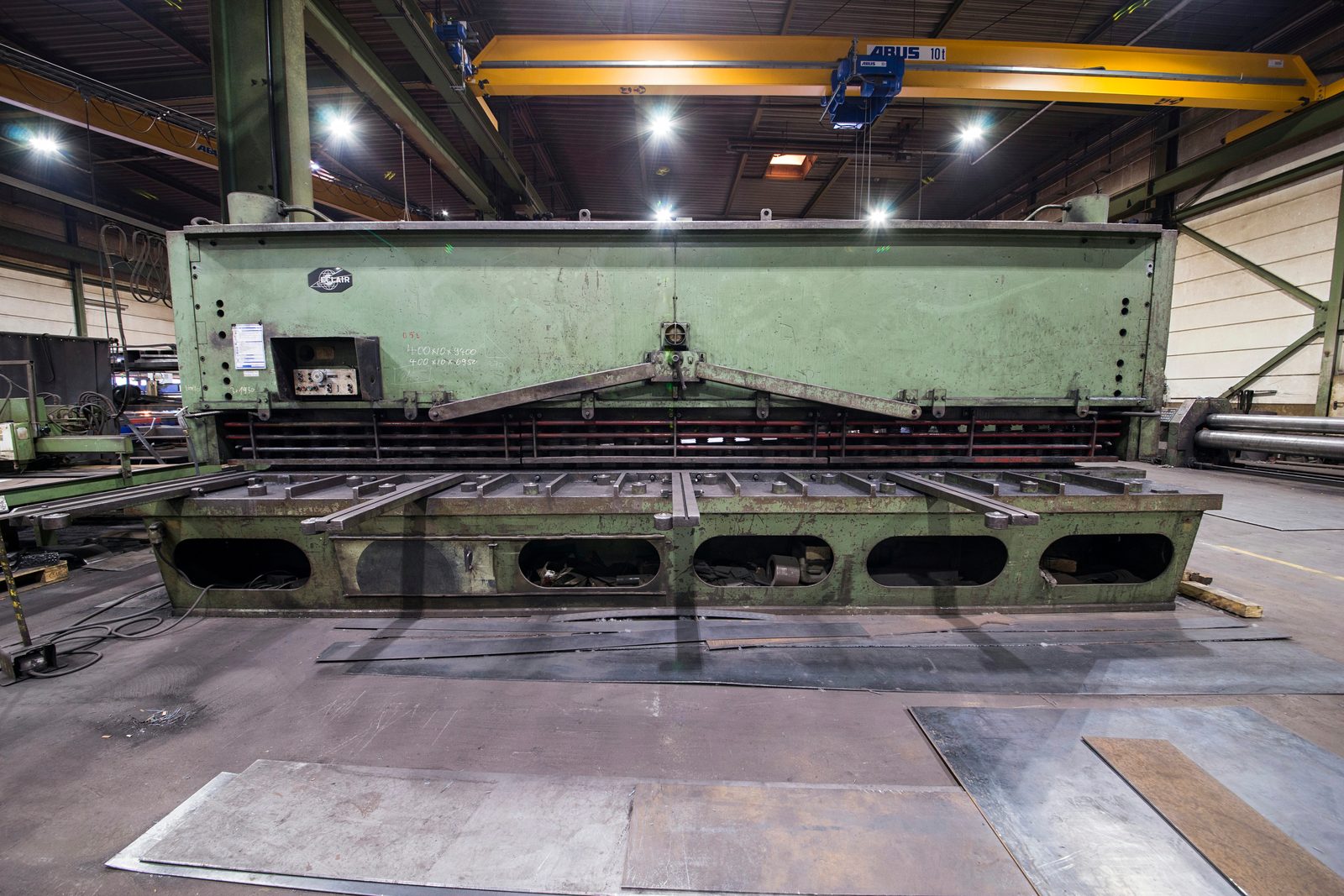
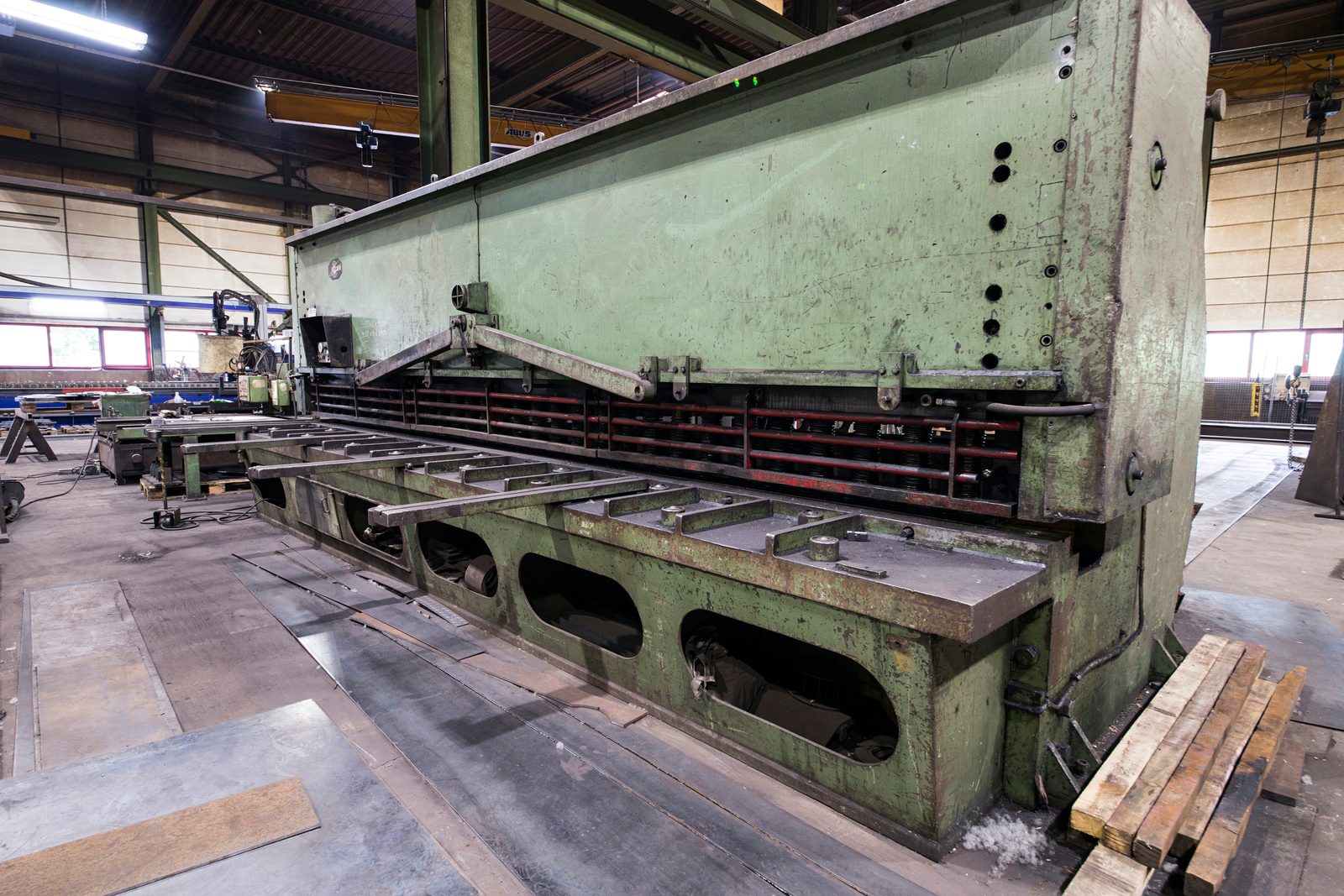
Shear sheet metal precisely and heat-free to size: the guillotine shear parts the plate by purely mechanical action – a clean cut edge with no heat-affected zone, no distortion, ready for immediate further processing. Large format up to 6,100 mm cutting length in Lorch — Ostalbkreis, the Stuttgart area, southern Germany.
A cold, purely mechanical cut – no heat-affected zone, no microstructural distortion, no discolouration.
A low-burr, straight edge – ready to weld and bend directly, with no rework.
Cutting length up to 6,100 mm – large plates in a single stroke, matched to large-part manufacturing.
Plate thicknesses up to 15 mm are parted purely mechanically.
Fast, cost-effective cutting for thin to medium-gauge sheet.
Cutting directly as a preparatory stage for press-brake bending and welded assemblies – all from a single source.
In technical terms, sheet metal shearing is a shear cutting process to DIN 8588: the plate is parted purely mechanically between two blades – an upper blade shears the material against a fixed lower blade, entirely without heat. The material is first deformed elastically, then plastically, initiates a fracture at the cutting edges and is cleanly severed. Unlike flame, plasma or laser cutting, no heat-affected zone forms – the microstructure remains unchanged, the plate does not distort and shows no temper colours.
The upper blade is set at a slight shear angle (rake) of around 2–3° relative to the plate. This means the full length is not severed in a single stroke but progressively – which considerably reduces the required cutting force and is what makes very long cuts possible in the first place. A hold-down clamps the plate firmly before the cut and holds it flat. It is precisely this principle that allows the cutting length of up to 6,100 mm.
The Bock Maschinenbau guillotine shear cuts plate up to 15 mm thick over this cutting length of up to 6,100 mm. This makes it possible to cut even large plates to length in a single stroke – a format that exceeds the 3,000–4,000 mm common to guillotine shears and matches exactly the large-part manufacturing Bock stands for.
The sheared edge is low in burr and straight and can be processed further directly without rework – for example as a base plate, connection plate or gusset plate for welded assemblies, or as a blank ahead of press-brake bending.
Cut plates are produced from drawings or cut lists – from the single part to series production, with no minimum quantity. For thin to medium-gauge sheet, mechanical shearing is faster and more economical than thermal processes and requires no cutting gas or heat-related wear.
Cutting is carried out under documented quality procedures to DIN EN ISO 9001:2015 with full material traceability – as the integrated first step of contract manufacturing in Lorch.
A sheared plate edge has a characteristic, clean structure. Because it is parted purely mechanically and cold, it stays square to the plate surface and free of slag, oxide edge and temper colours. The typical zones of the cut face in shear cutting:
The result is a low-burr, straight and square edge that can be welded, bent or machined directly without deburring – with high repeatability across the entire cutting length.
| Machine | Cutting length | Plate thickness |
|---|---|---|
| Eclair · Guillotine shear | 6,100 mm | up to 15 mm |
Mechanical shearing and thermal cutting complement one another – the right choice depends on plate thickness, edge quality and cut geometry:
Straight cuts from thin to medium-gauge sheet, where a clean, heat-free edge with no distortion is required.
Thick plates, internal cut-outs or any contour – in those cases flame or plasma cutting is the right choice.
| Criterion | Guillotine shear mechanical | Flame / plasma cutting thermal |
|---|---|---|
| Heat input | none – a cold cut | Heat-affected zone at the cut edge |
| Cut edge | low-burr and ready for immediate processing | Slag/oxide edge, rework may be required |
| Plate thickness | up to 15 mm | up to 50 mm and more |
| Cut geometry | straight cuts | any contour |
| Thin sheet | highly economical | less economical |
| Distortion | minimal | thermal distortion possible |
The following are mainly sheared on the guillotine shear:
Customer-supplied material is accepted on request.
Sheared plate blanks are used for:
Cut plates are handed over directly to press-brake bending, welded assemblies and CNC machining – all steps from a single source in Lorch, with no external logistics.
Plate cutting as an integrated step of contract manufacturing:
Steel fabricators, metalworking shops and metal processors from the Ostalbkreis, the Stuttgart area and the DACH region have us shear plate to size here – from stock, with no minimum order.
Shearing parts the plate purely mechanically, without heat. No heat-affected zone, no thermal distortion and no oxide edge form – the edge is ready for immediate further processing. For thin to medium-gauge sheet, shearing is faster and more economical; for thick plates or any contour, thermal processes are the right choice.
Shear cutting (DIN 8588) is the mechanical parting of plate between two blades – an upper blade and a fixed lower blade. The plate is deformed elastically, then plastically, initiates a fracture at the cutting edges and is parted without chips and without heat. The guillotine shear is the classic machine for straight shear cuts in sheet and plate.
The edge shows the typical shear-cut structure – a slight roll-over, a bright burnish zone, a small fracture zone and only minimal burr. It is square to the surface and, because it is parted cold, free of temper colours and distortion – ready for immediate further processing.
No. The cut is cold, so there is no thermal distortion. A hold-down clamps the plate firmly before the cut and holds it flat, and the slight shear angle of the upper blade keeps the cutting forces low – so the cut parts stay dimensionally accurate and flat.
On the guillotine shear, structural steel plate is parted up to 15 mm. The maximum thickness depends on the material – higher-strength and stainless steels considerably reduce the achievable cutting thickness.
The cutting length is up to 6,100 mm – large plates can be cut to length in a single stroke, matched to large-part manufacturing at Bock.
Yes. Cut plates are produced with no minimum quantity – from the single part to running series production, to drawing or cut list.
No. Bock cuts using plasma – including 3D tube cutting –, oxy-fuel cutting, guillotine shearing and saws. Laser and waterjet cutting are not part of the service range.
Send us your drawing or cut list with material, plate thickness and quantity. We will prepare a quotation for the cutting.