Steel construction apprenticeship: trades, training and real projects
Contents
What steel fabricators build: crane runways, machine frames and more
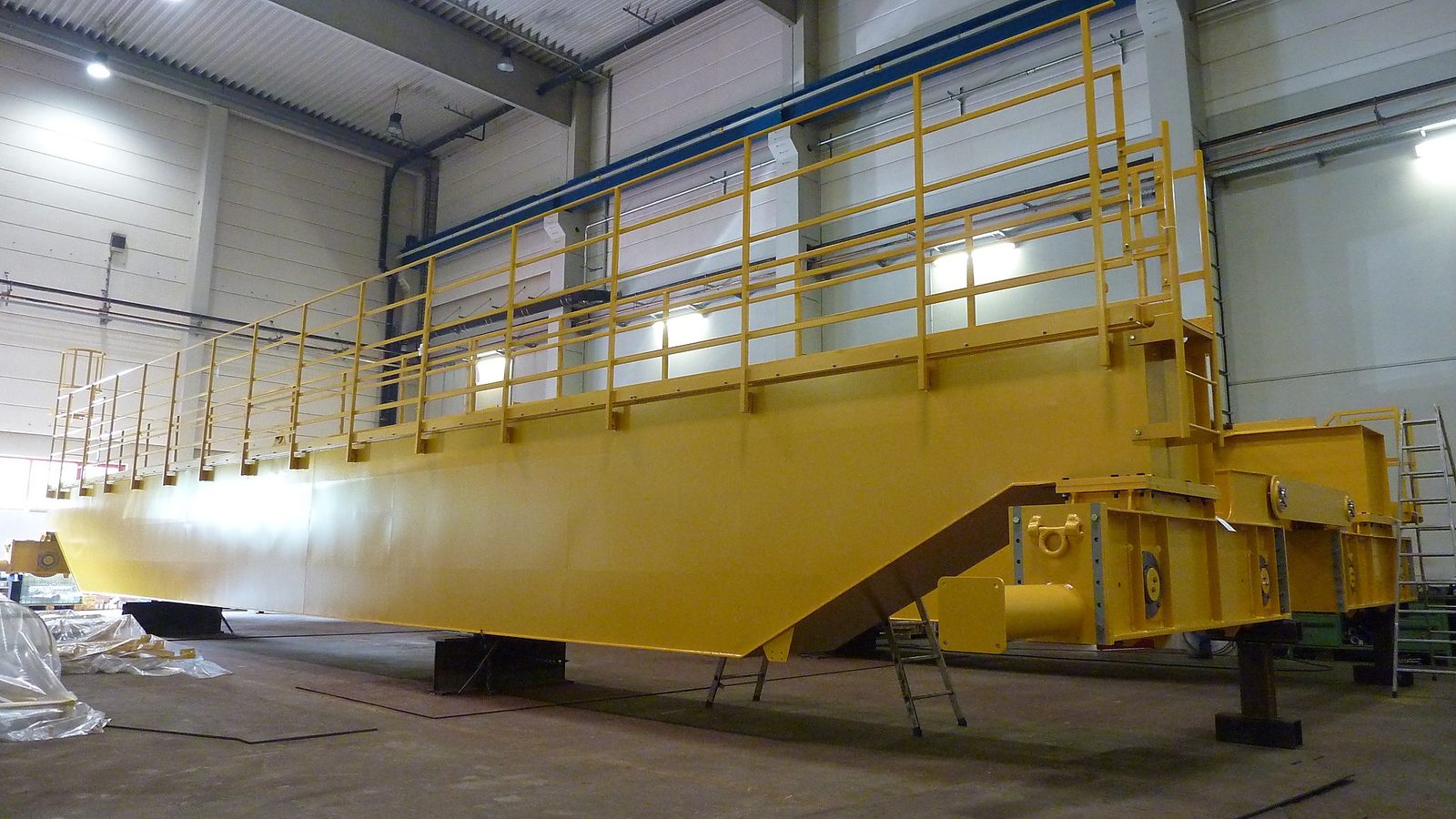
A crane runway above a factory floor, a bridge girder across a river, a drilling mast on a construction site: each starts as separate pieces of steel. Steel fabrication turns those pieces into structures that carry loads and machines that do useful work. An apprenticeship teaches how to build them, from the drawing to the finished assembly.
Much of this work is made to order. A crane jib belongs to a particular crane; a machine bed is built for a particular machine. One-off parts and small batches call for a fresh look at the drawing, the setup and the assembly sequence with each order.
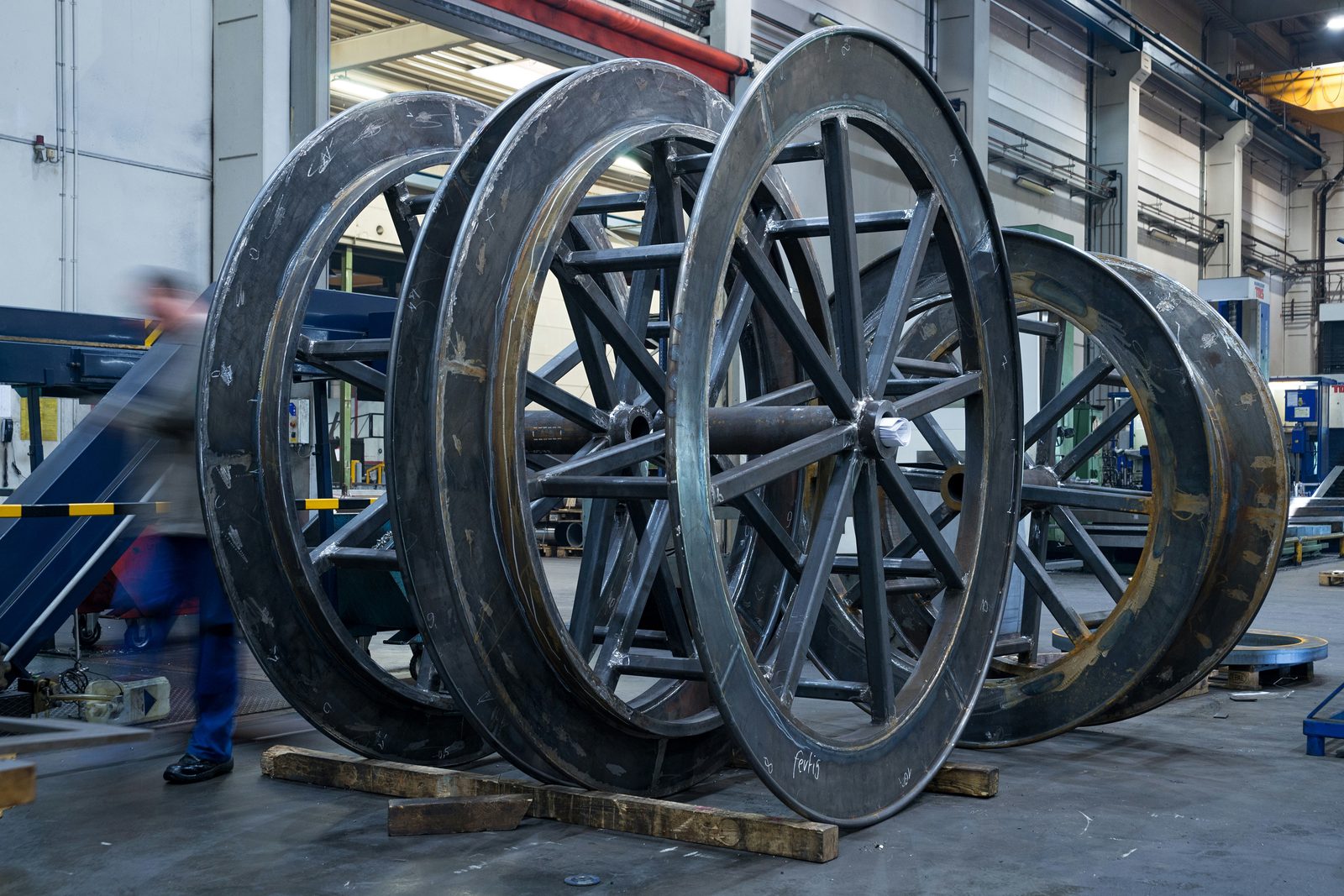
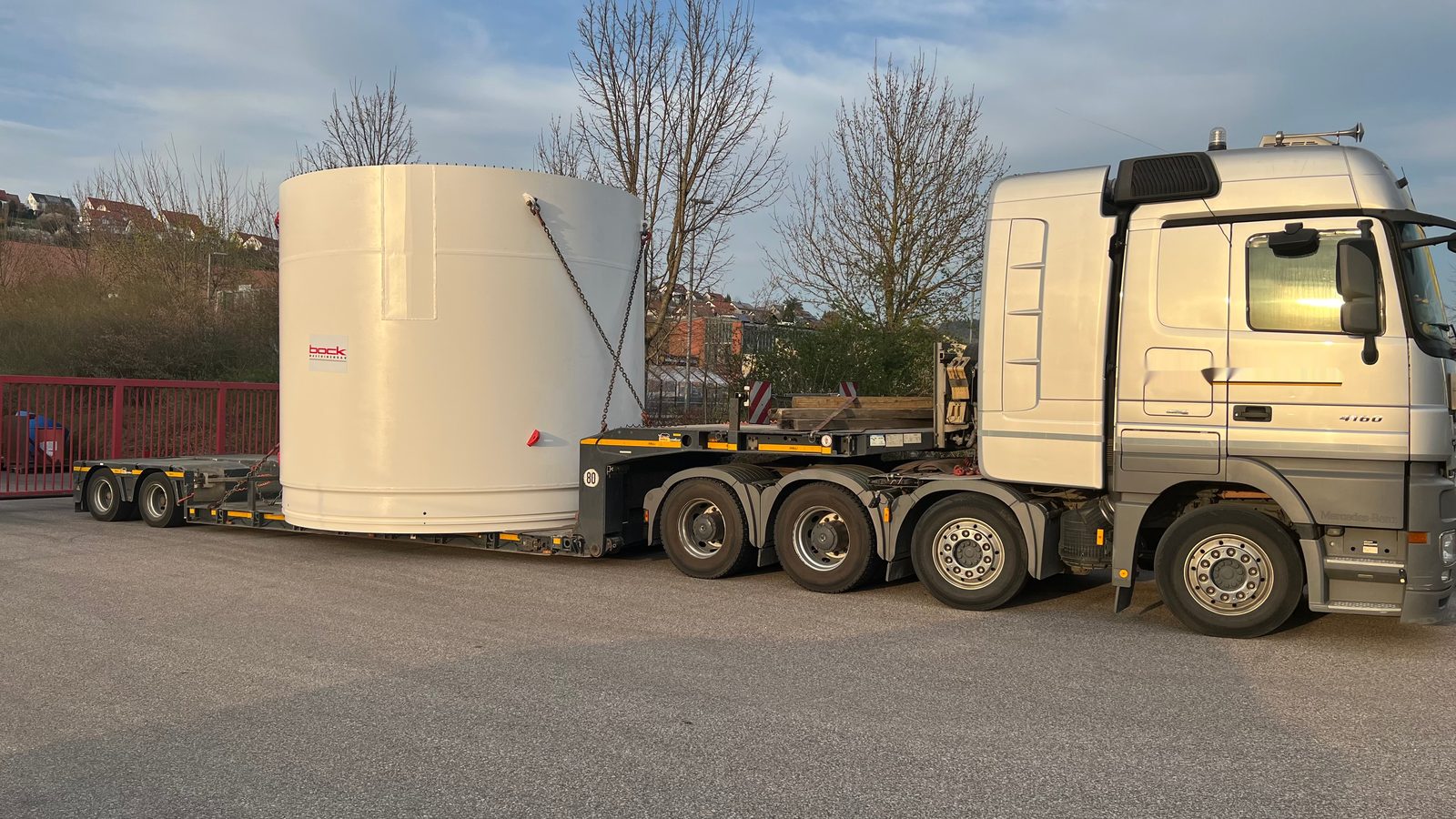
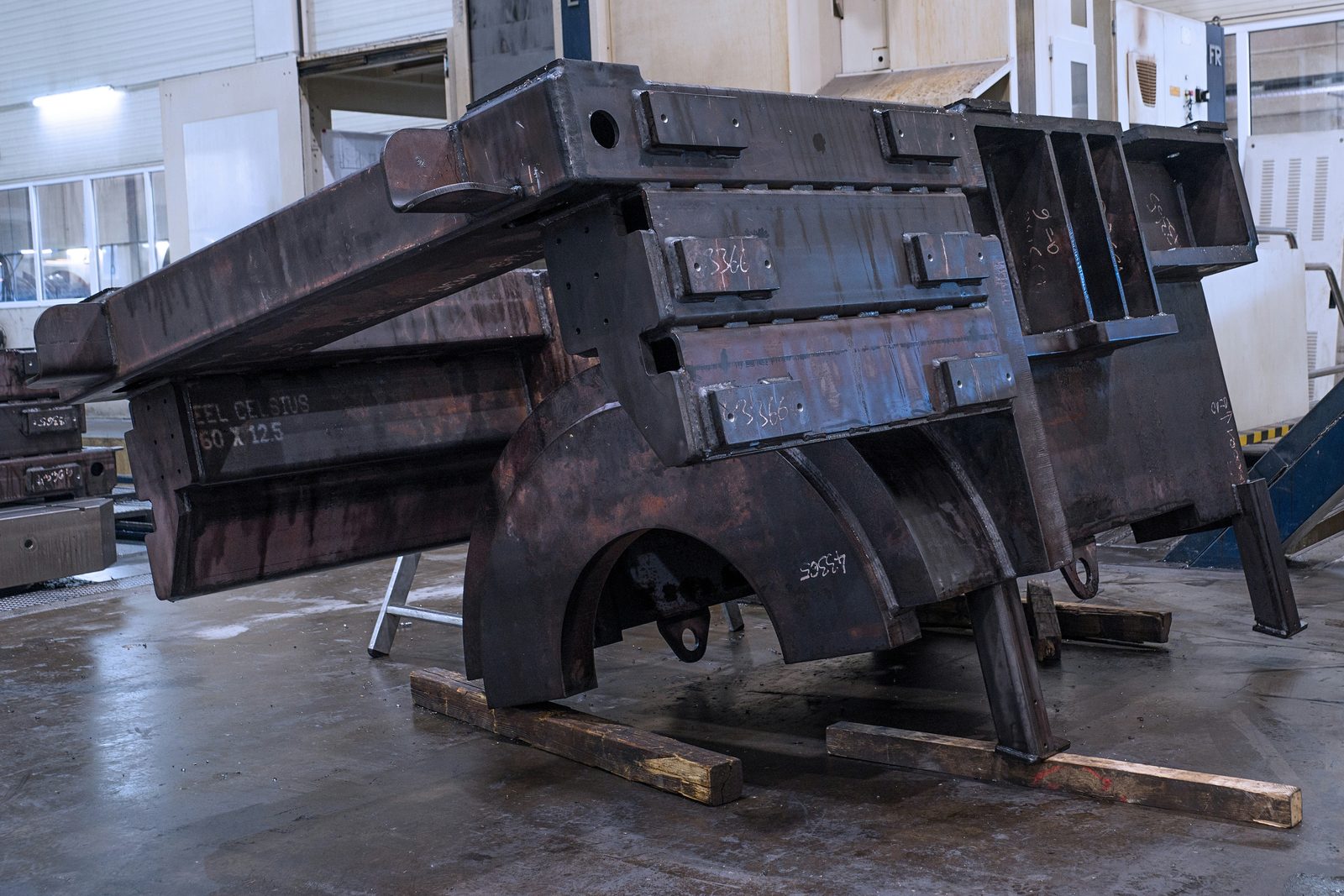
And the dimensions do not stay on paper. A unit weight of 50 t means that nobody carries this component – it hangs from the crane, and whoever slings it works out beforehand where the centre of gravity lies. Component lengths of up to 26 m mean that you walk along your own workpiece instead of standing in front of it. A plate 200 mm thick is not a figure on a drawing but a piece of steel an excavator could stand on.
The appeal is tangible: over days or weeks, separate parts become a structure standing on the workshop floor. Its size, shape and purpose make the result of the work easy to see.
From steel plate to finished assembly: six production stages
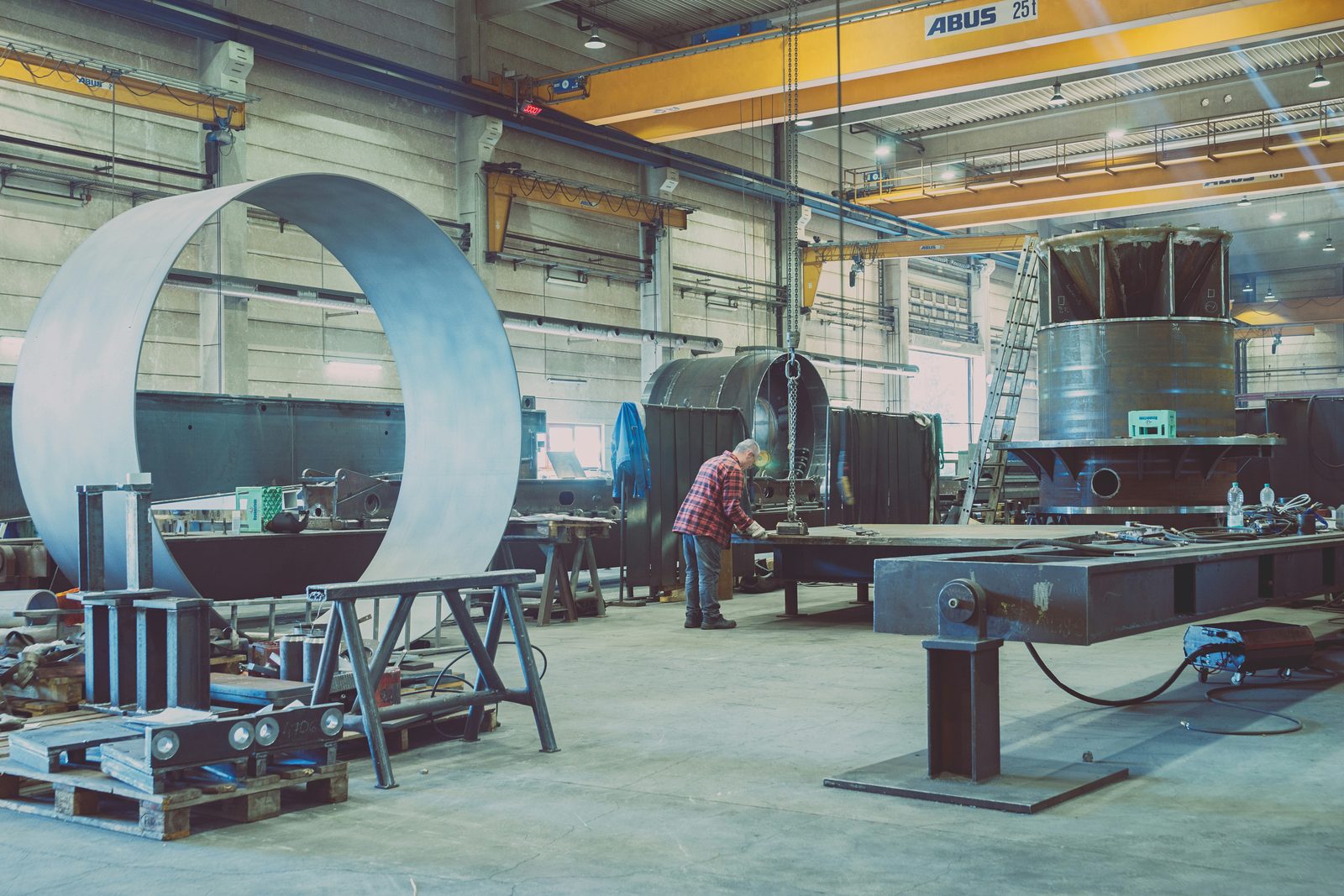
Following a component through the workshop makes the roles easier to understand. A steel plate can pass through six main production stages before leaving as a painted assembly ready for installation:
- Cutting: the individual parts are cut from the plate – oxy-fuel flame cutting up to 200 mm material thickness, plus CNC plasma cutting. This is where the first edge is created, the one to which all other dimensions will later refer.
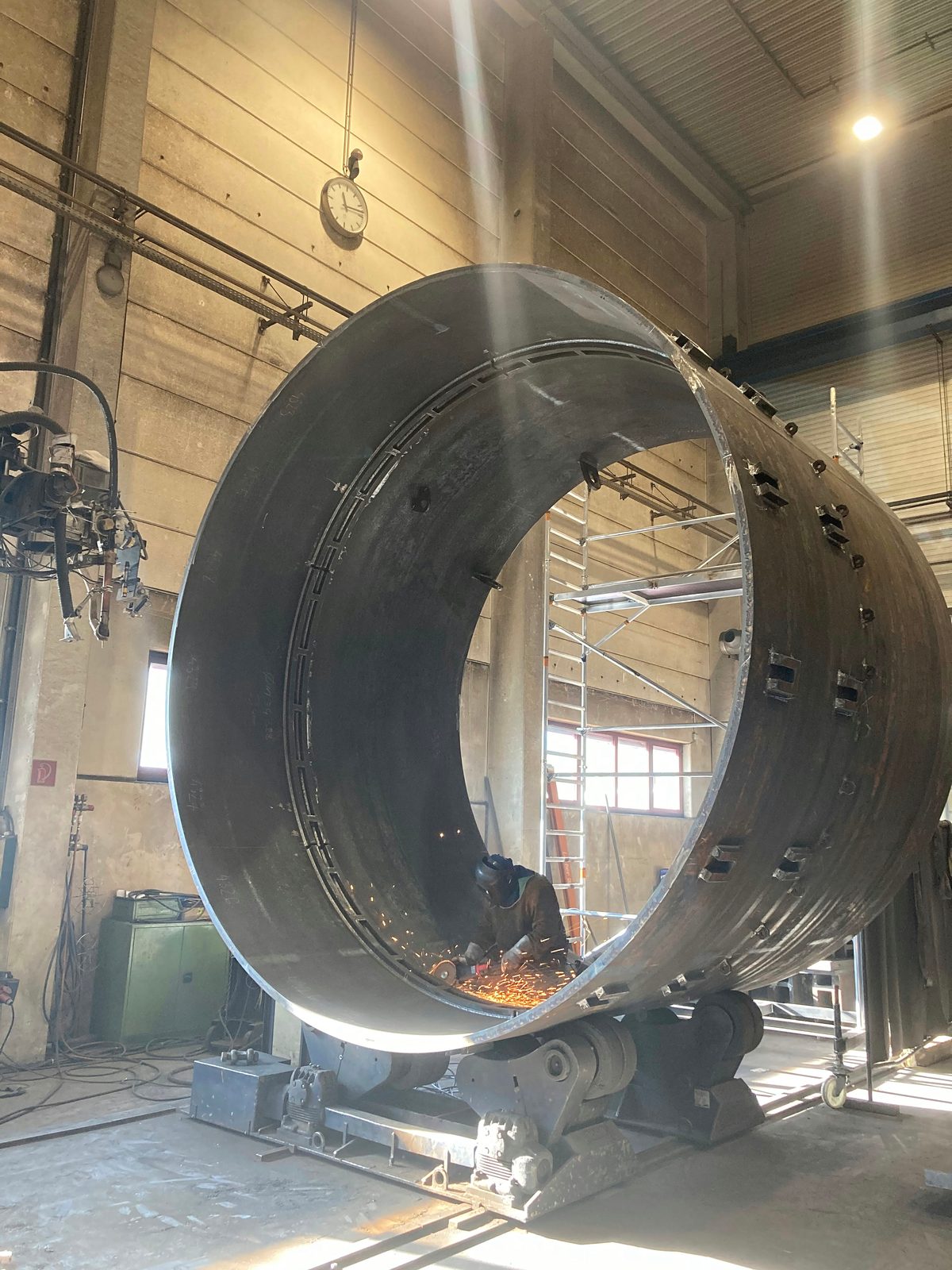
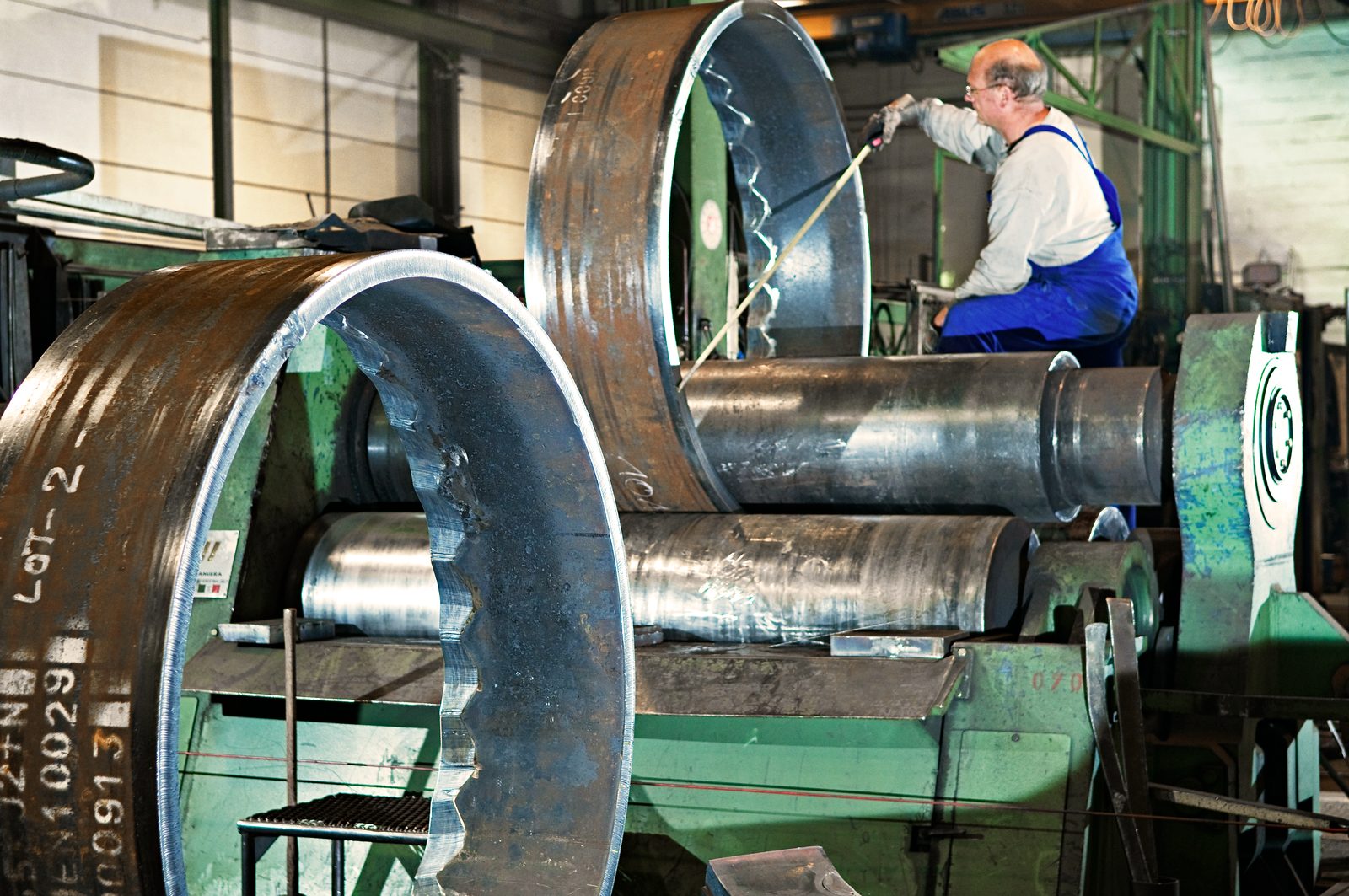
- Forming: rolling and press brake bending turn the flat blank into a curve or an angle. A tube, a cone, a shell – everything that is not flat passes through this station.
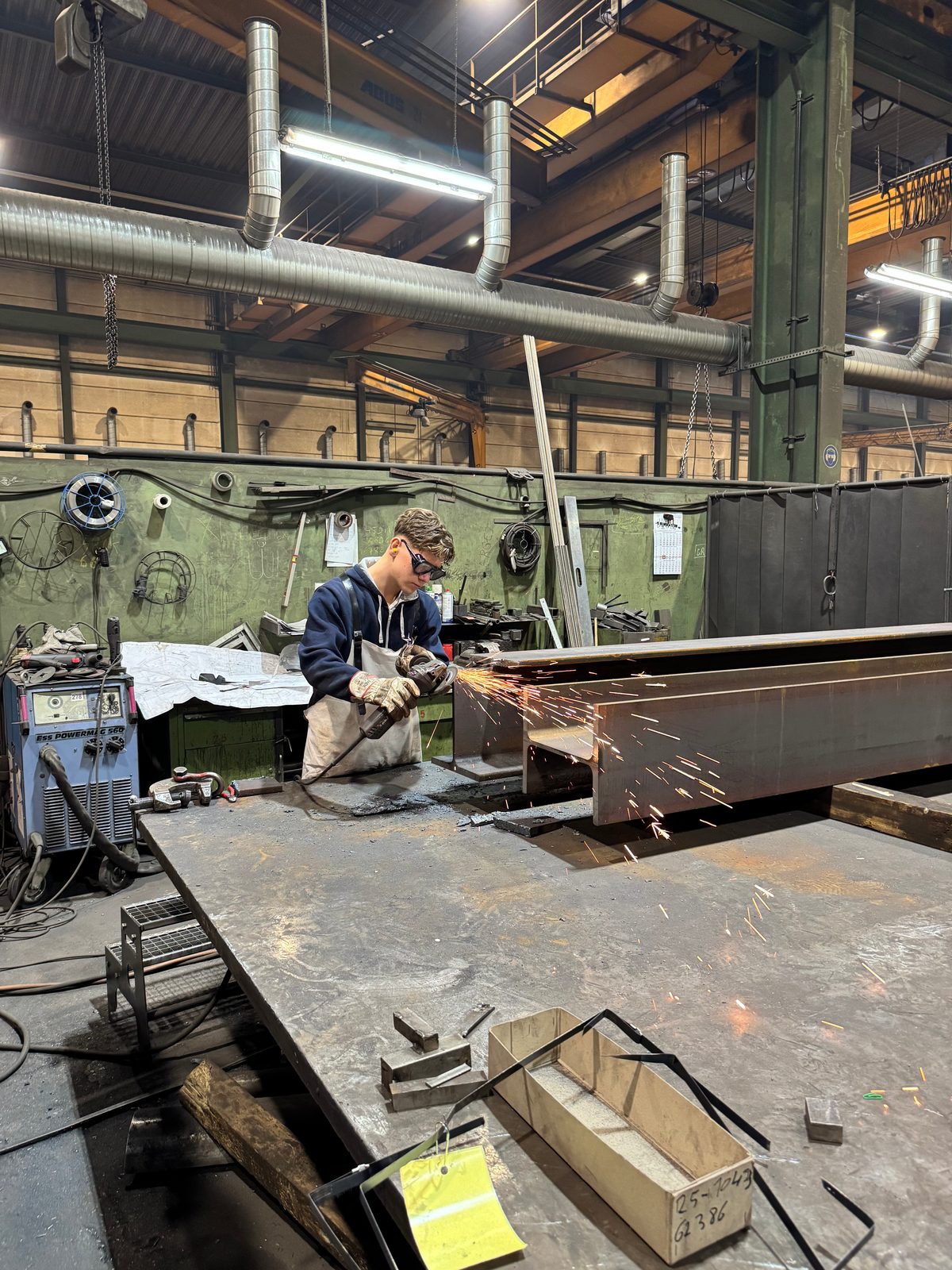
- Fitting shop: the individual parts are marked out, straightened, drilled and tack-welded into an assembly. This is where the dimensional accuracy of the whole structure is decided, long before the first load-bearing weld is laid.
- Welding: the tack-welded assembly becomes a load-bearing structure – welded to DIN EN 1090-2 EXC3 (execution class 3 for steel structures) and EN ISO 3834-2 (quality requirements for welding), supervised by our own welding coordination (IWE/EWE, International/European Welding Engineer).
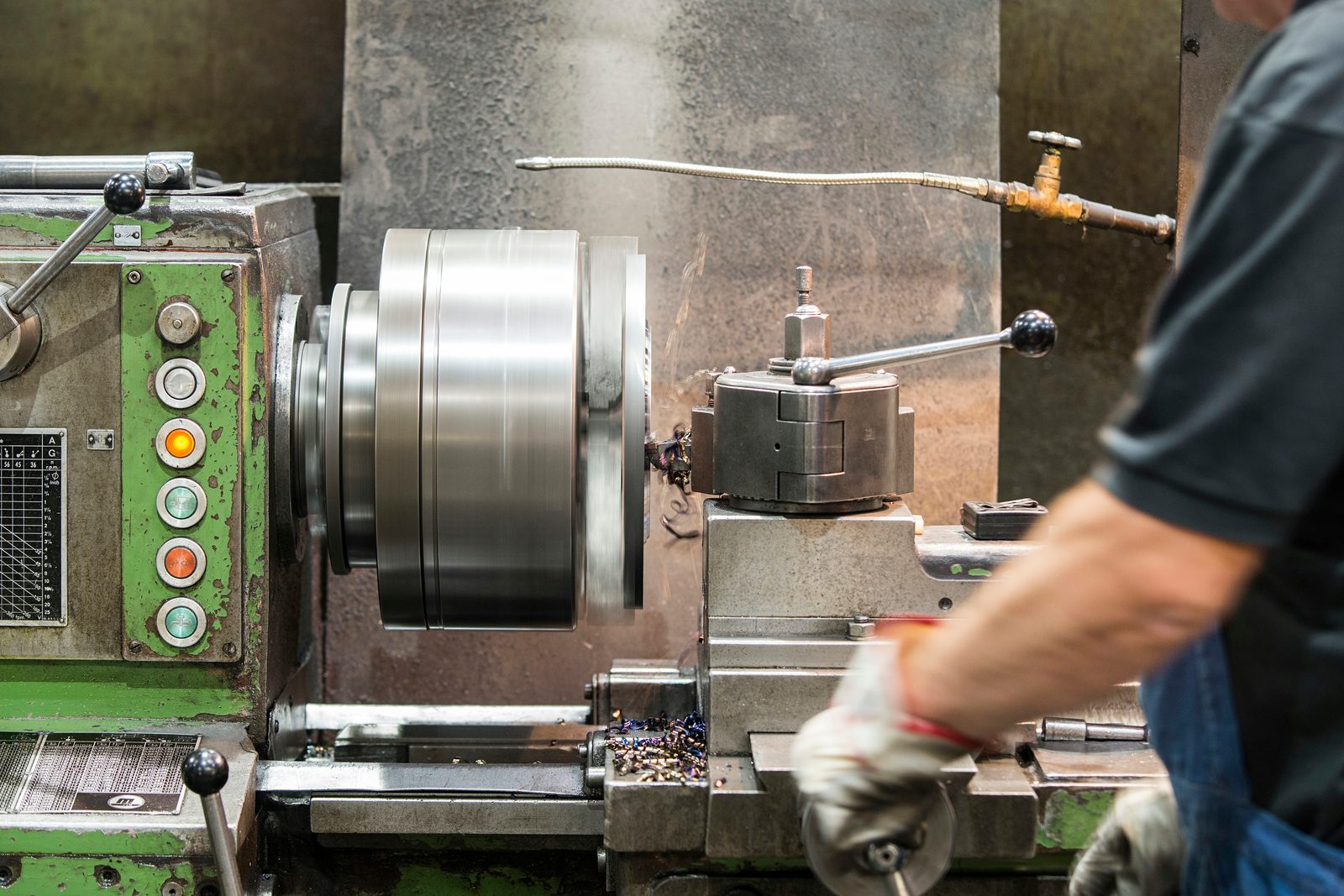
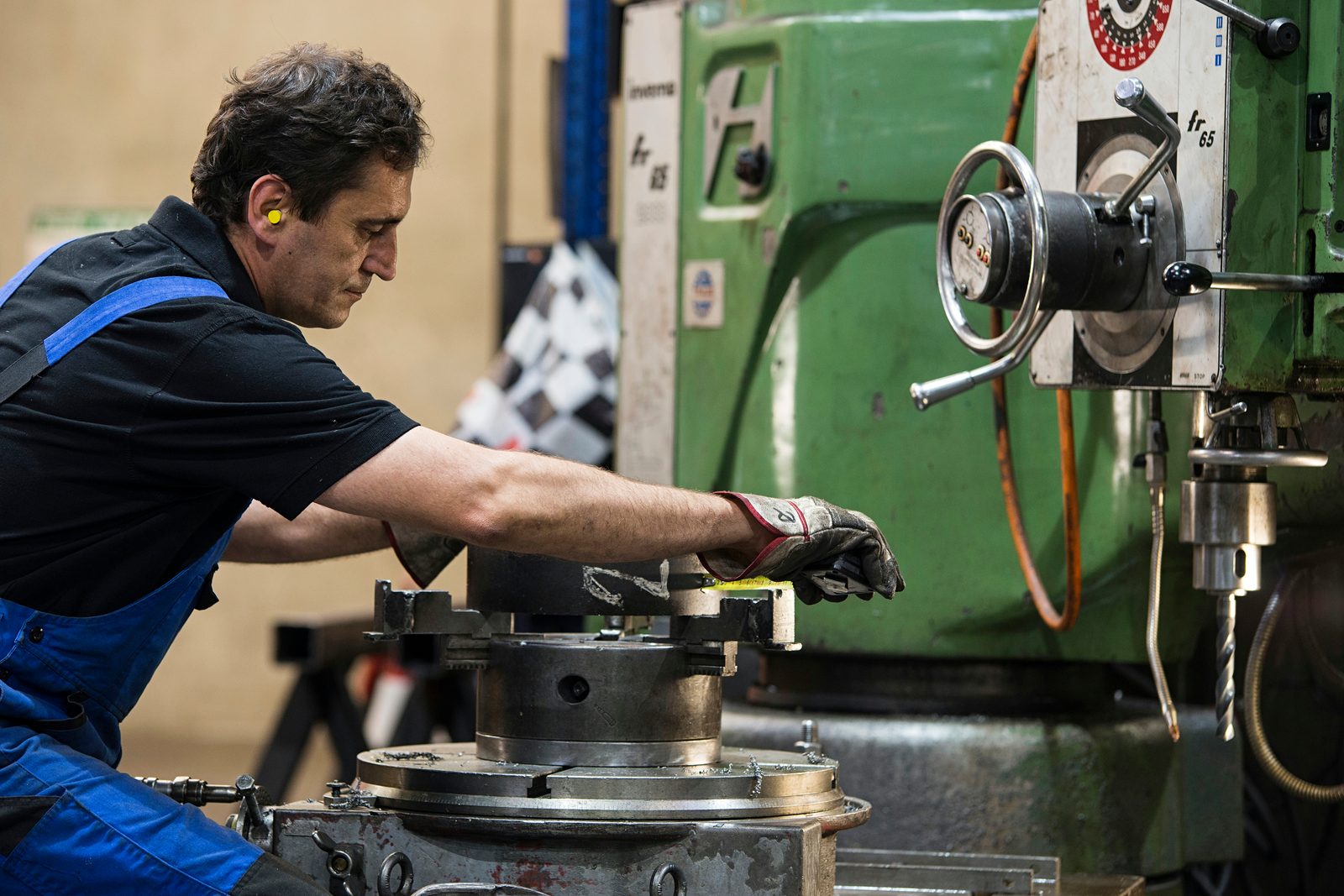
- Machining: on CNC milling machines and boring mills, the welded assembly receives its functional surfaces – fits, bore patterns, bearing faces. Deliberately after welding, so that the distortion from the weld stays outside the dimensional chain.
- Surface: blasting and painting. After that, the component goes onto the low-loader.
Each stage calls for different skills. Fitters plan how the parts come together; machinists plan how to produce accurate surfaces and bores; welders control the joints that carry the load. Seeing the sequence helps explain which work might suit a prospective apprentice.
The six stations in pictures
The same chain as photos, in the order in which a component passes through it: cutting on the plasma cutting system, rolling on the plate rolls, grinding inside a rolled ring, welding on an assembly, machining on the boring mill and finally the paint booth. Every image can be enlarged.
Fitter, machinist or welder: which trade suits you?
A useful way to compare the trades is to look at what each person produces, how they work and when they can check the result:
| Feature | Structural metal fitter | CNC machinist | Welder |
|---|---|---|---|
| What you end up with | An assembled steel structure – frame, rack, assembly | A machined surface, a fit, a bore pattern | A load-bearing weld that holds a structure together |
| Core of the work | Marking out, straightening, tack welding, fitting, measuring | Programming, setting up, clamping, machining, inspecting | Preheating, setting the position, welding, inspecting the weld |
| Where you spend the day | At the component, with tools and measuring instruments in hand | At the machine and its control, plus the measuring instruments | At the weld, in protective clothing, with intense concentration |
| Feedback comes | Late – a large assembly takes days to weeks | Quickly – a chip, a surface, a dimension | Immediately visible in the weld, final only after inspection |
| At Bock | Dual apprenticeship trade, 3.5 years | Dual apprenticeship trade, 3.5 years | NOT an apprenticeship trade – route via a metalworking apprenticeship plus a welder qualification test |
The fitter assembles the structure, the machinist produces its precision surfaces and bores, and the welder completes the joints. Their work overlaps, but the main focus differs. Welding is taught within metalworking apprenticeships; it is not a separate trade in Germany’s current dual apprenticeship system.
Structural metal fitter: tasks, training and career paths
How do separate steel parts become an accurately fitted machine frame? A look at the work, judgement and German training route behind structural metal fitting.
Explore the trade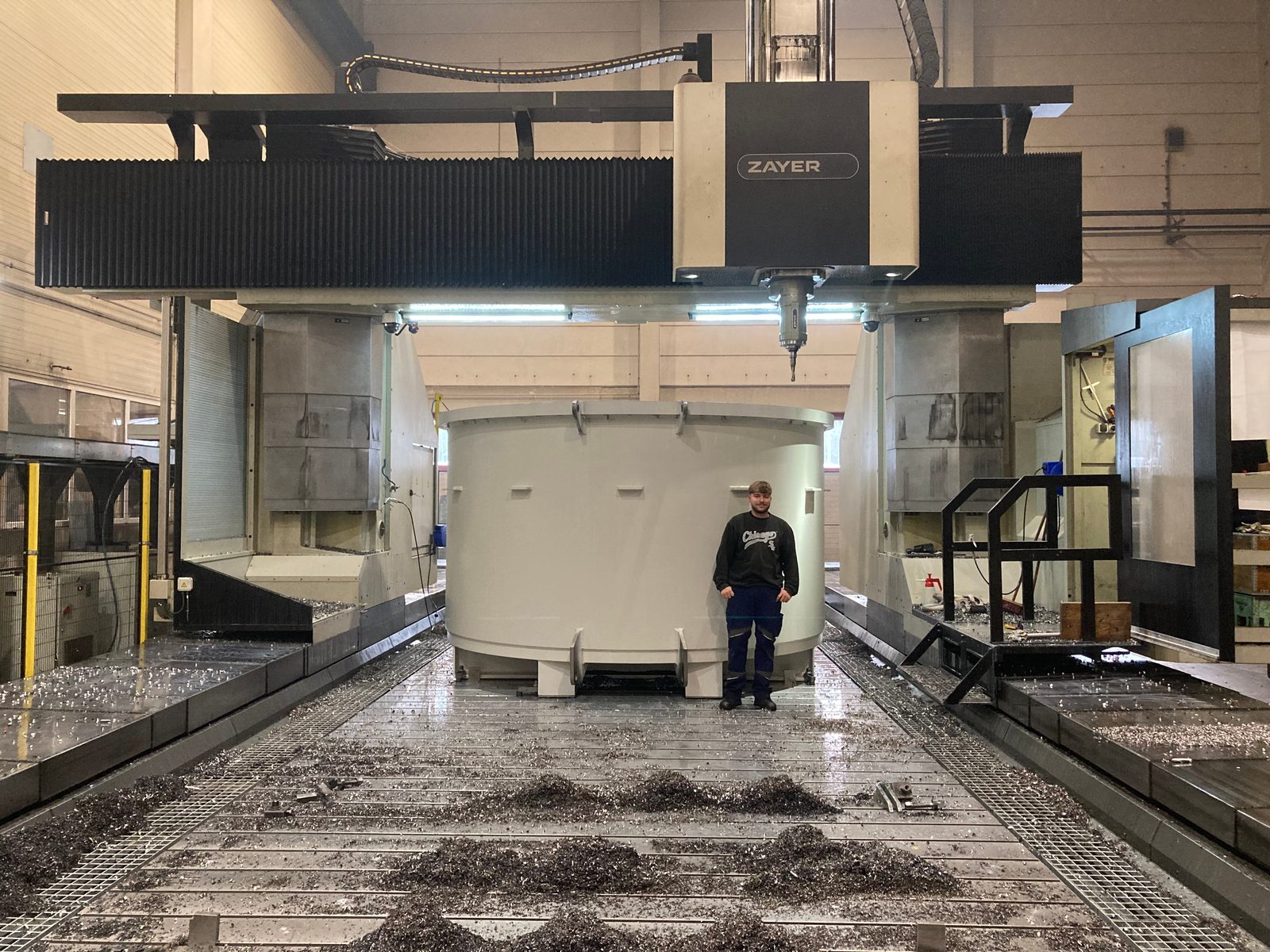
CNC machinist: tasks, training and career paths
Before the first cut comes the setup. Discover how CNC machinists plan, program and inspect large components, and how the German apprenticeship builds those skills.
Explore the trade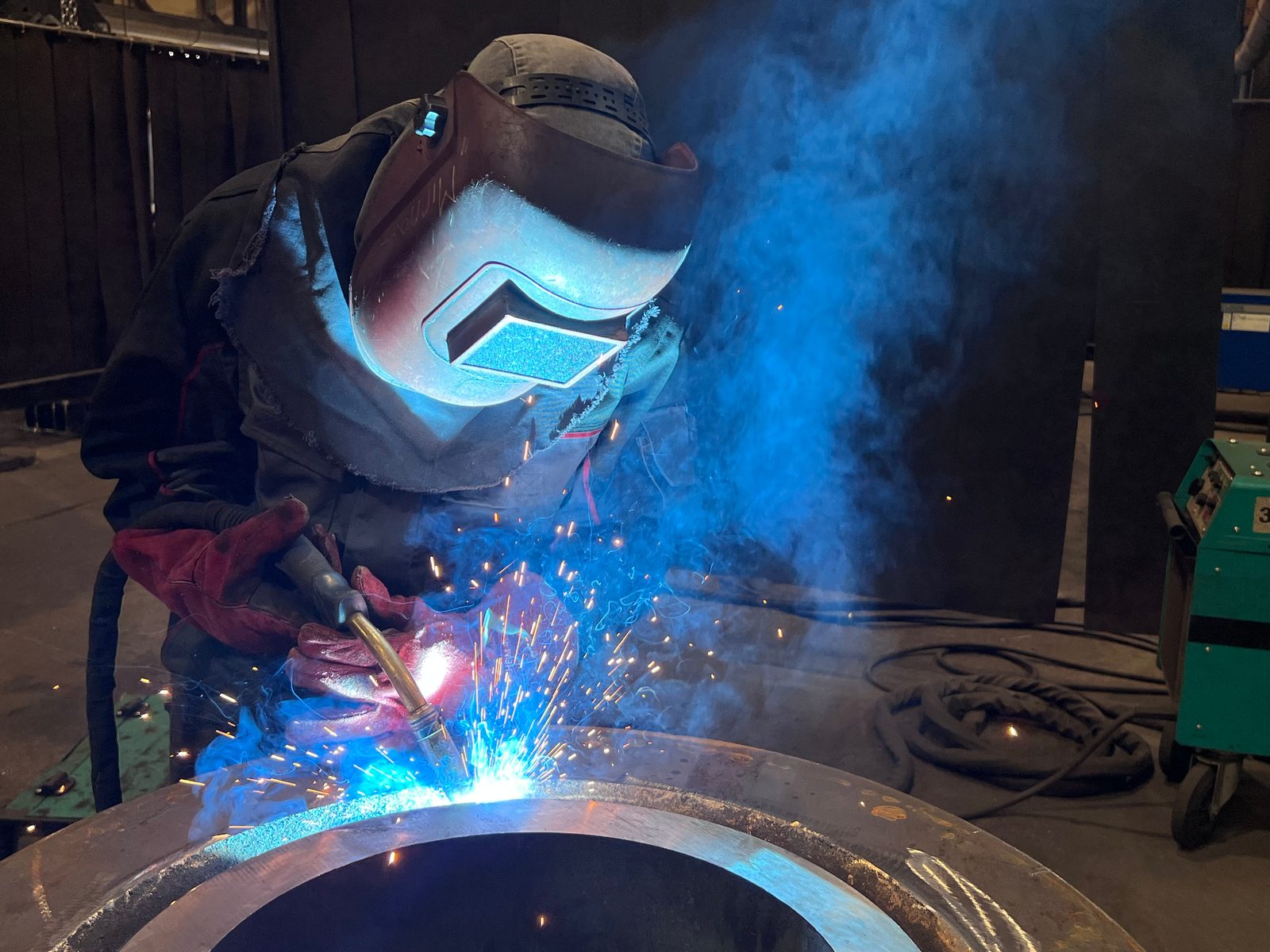
Welder: tasks, processes and qualifications
There is more to welding than laying a bead. Explore joint preparation, MAG, TIG and submerged arc welding, and the qualifications used in Germany.
Explore the tradeHow training works: 3.5 years in the company and at vocational school
Germany’s dual apprenticeship system combines practical training at a company with lessons at vocational school. Both metalworking apprenticeships described here normally take 3.5 years, building skills in stages:
- Basic techniques first: measuring, marking out, sawing, filing, drilling. These are the manual skills on which everything later builds – regardless of which direction you take afterwards.
- Reading drawings: identifying reference edges, understanding dimensions and planning how parts fit together. These skills develop alongside the practical work throughout the apprenticeship.
- Real work instead of practice pieces: you work on current orders, not on workpieces that end up as scrap afterwards. The first part of your own that is shipped with an order comes sooner than most people expect.
- A final examination in two parts: one during the apprenticeship and one at the end. Both contribute to the final result, so the skills learned early on count towards the qualification.
- Checking your own work from the start: re-measuring your own workpiece is part of the job from the first year of the apprenticeship, not only during exam preparation. Quality control starts here with your own part, not at the end of the hall.
Entry is deliberately accessible, but not the same everywhere: for the Konstruktionsmechaniker a good Hauptschulabschluss (lower secondary school certificate) is enough; for the Zerspanungsmechaniker the Mittlere Reife (intermediate school certificate) or a very good Hauptschulabschluss, plus good maths skills, because machining involves constant calculation. For the commercial apprenticeship a good Realschulabschluss (intermediate secondary school certificate) is expected. More important than grades are technical interest, care and reliability: anyone who would rather measure a dimension three times than estimate it once will go far here.
What is different after the first year
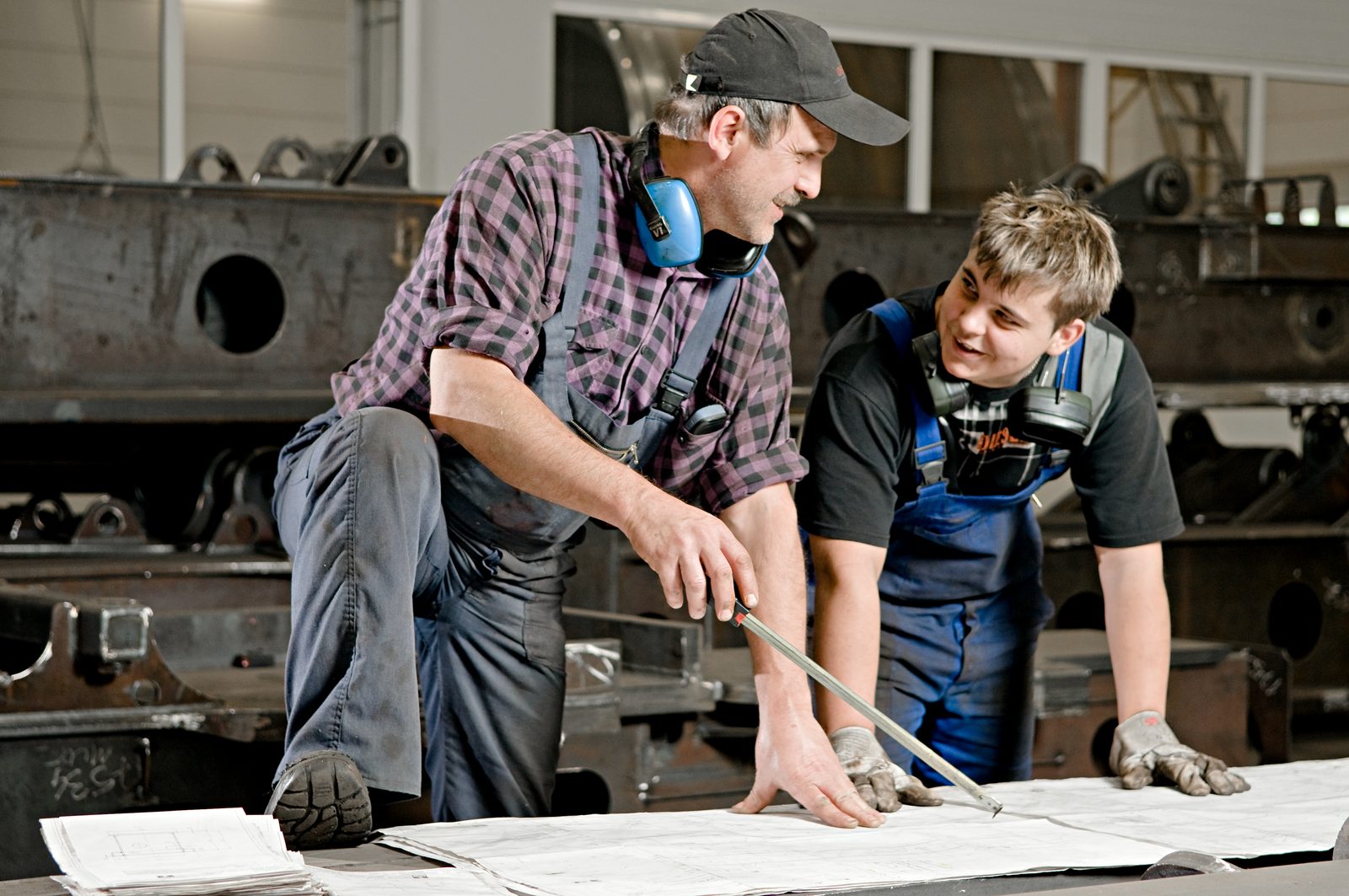
At the beginning the question is what needs to be done. After a while the question is in which order. That is the real progress in these trades and the reason why the apprenticeship lasts 3.5 years: clamping a component correctly, anticipating the distortion of a weld or recognising which dimension depends on which – you do not learn that from a book, but from working on enough components.
On top of that comes a feel for material. Structural steel behaves differently from fine-grain structural steel up to S1100, wear-resistant steel differently from stainless steel. Knowing which of them needs heat before welding and which does not is knowledge gained from experience – it develops where enough different materials pass through the same hall.
Responsibility grows with experience. On a one-off component, each check matters because there is no repeat production run to rely on. Apprentices begin taking responsibility for their own workpieces early, learning to plan, measure and ask for help when something is unclear.
What training in a family-owned manufacturer is like
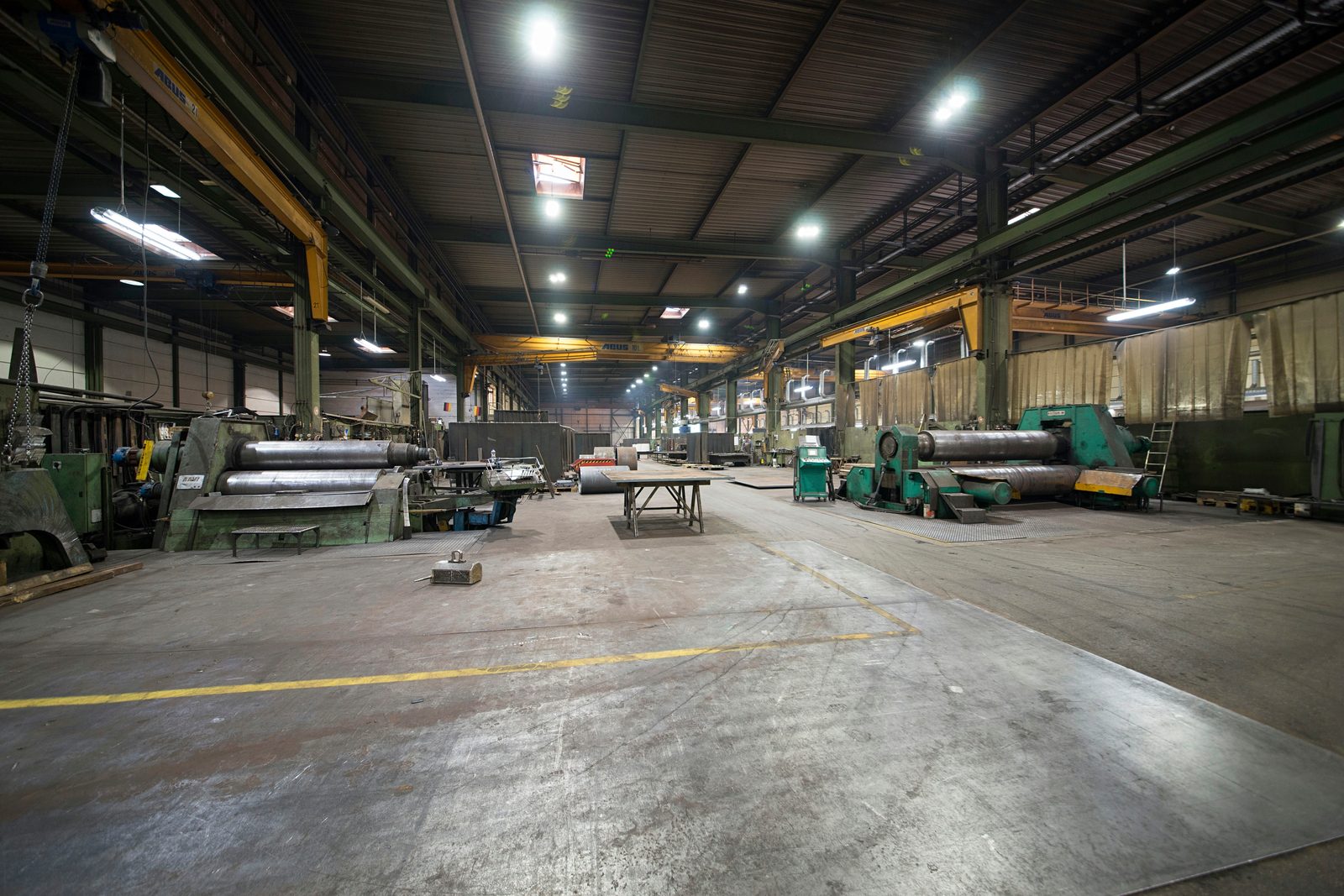
The trade is the same everywhere – the company in which you learn it is not. At Bock all production steps are under one roof on 14,000 m², and that changes what you get to see in 3.5 years:
- The whole chain instead of one section: cutting, forming, fitting, welding, machining, inspection and painting are in the same building. In a pure assembly company, the view ends at the hall door.
- Real components instead of a training workshop: you learn alongside someone who has been doing the job for years, on orders that are delivered to customers.
- Qualifications in-house: welding coordination (IWE/EWE), non-destructive testing (VT, PT, MT to ISO 9712, the standard for qualifying NDT personnel) and the certifications to DIN EN 1090-2 EXC3, EN ISO 3834-2, ISO 9001 (quality management) and AD 2000 HP 0 (German pressure equipment code) – if you have a question, you will find the answer within the company.
- Range of materials: a stock of more than 40 grades – from structural steel and wear-resistant steel such as Hardox up to S1100, plus stainless steel. Materials come with an inspection certificate 3.1 to EN 10204.
- A family business with 63 years of manufacturing experience: short distances, familiar faces – and customers from crane building, vehicle construction, plant engineering, bridge construction and special foundation engineering who keep the company stable even when a single industry is going through a weak phase.
For the apprenticeship this means one thing above all: you see your component through the whole chain – from the plate to the painted assembly on the low-loader. That is the difference between "I work in production" and "I know how this is made".
What to consider before choosing steel fabrication
Steel fabrication offers visible, practical results and comes with specific demands. Consider these aspects when choosing a trade:
- Physical activity: much of the work involves standing, using tools and moving around large components. Protective clothing is part of the working day in a noisy production environment.
- Time to completion: large assemblies take days or weeks. Progress is visible at each stage, while the finished result takes patience.
- Careful measurement: checking your own work is central to all these trades. Accurate dimensions help the next colleague carry on without avoidable rework.
- Practical fabrication: production teams turn drawings into components. Technical drafting and design offer a different route for those more interested in creating the drawings.
- Changing work: one-off parts bring different drawings and assembly sequences. Curiosity and a willingness to adapt are useful throughout a career in this workshop.
Career paths after the apprenticeship
The skilled-worker examination ends the apprenticeship, not your development. After a year in assembly you read drawings differently than on your first day – and take on assemblies where the order is no longer specified but has to be worked out.
The neighbouring trades are not a job advertisement in another town but the hall next door: in the welding shop, welds to DIN EN 1090-2 EXC3 are made by welders with a valid welder qualification test to DIN EN ISO 9606-1 (qualification testing of welders for steels); in machining, CNC gantry milling machines and boring mills are running; in quality assurance, non-destructive testing is carried out. If you want to develop in one direction, you do not have to leave the company to do so.
On pay, we deliberately do not quote a flat rate: it depends on qualification, professional experience, area of work and individual agreement. What is firmly promised, on the other hand, is holiday pay and special payments, 30 days of annual leave, a company pension scheme and capital-forming payments, company health insurance and a travel allowance.
Apprenticeship places at Bock
We train apprentices in three trades – two in production, one in the commercial area. The apprenticeship usually starts in September:
- Konstruktionsmechaniker / fitter (m/f/d): basic metalworking techniques, assembly and installation of steel assemblies to drawing, tacking with auxiliary welds, quality control. Requirements: a good Hauptschulabschluss or Realschulabschluss, technical interest, manual skill.
- Zerspanungsmechaniker (m/f/d): setting up and operating CNC milling machines and lathes, reading technical drawings, writing your first CNC programs under guidance, quality inspection with measuring instruments. Requirements: Mittlere Reife or a very good Hauptschulabschluss, good maths skills and an interest in technology.
- Industriekauffrau / Industriekaufmann (industrial clerk, m/f/d): order processing, purchasing, accounting, production planning and ERP data – the commercial side of the same company. Requirements: a good Realschulabschluss or Abitur (university entrance qualification).
The workplace is in 73547 Lorch in the Ostalbkreis, near Schwäbisch Gmünd; the site is easy to reach from Schorndorf, Aalen, Göppingen and Stuttgart, and there is an allowance towards travel costs. If you are unsure which of the three trades suits you, the best thing is to ask – a conversation clarifies that faster than any description.
Apprenticeship work in pictures
Revisit the workshop images from this article. Select an image to return to its chapter.
-
The apprenticeship -
1 What steel fabricators build: crane runways, machine frames and more -
2 From steel plate to finished assembly: six production stages -
2 From steel plate to finished assembly: six production stages -
5 How training works: 3.5 years in the company and at vocational school -
6 What is different after the first year -
6 What is different after the first year -
7 What training in a family-owned manufacturer is like -
9 Career paths after the apprenticeship -
9 Career paths after the apprenticeship
Frequently asked questions about an apprenticeship in steel construction
What school-leaving qualification do I need for an apprenticeship in steel construction?
That depends on the trade. For the Konstruktionsmechaniker a good Hauptschulabschluss is enough. For the Zerspanungsmechaniker the Mittlere Reife or a very good Hauptschulabschluss, plus good maths skills. For the commercial apprenticeship a good Realschulabschluss or Abitur is expected. More important than grades are technical interest, manual skill, care and reliability. If you are unsure whether it is enough, the best thing is to ask us directly – a conversation tells more than a school report.
I don't know yet which trade suits me. Do I have to decide straight away?
No. The trades differ mainly in what is finished at the end of a working day: an assembled structure, a machined surface or a load-bearing weld. The most honest answer to this question is found on site. An internship or a conversation in the hall clarifies more in a few days than any job description.
How long does the apprenticeship last and how does the examination work?
The industrial-technical apprenticeships normally last 3.5 years in the dual system, alternating between the company and vocational school. The final examination is split: one part takes place halfway through the apprenticeship, the other at the end – both count towards the result.
As an apprentice, do I work on real orders or on practice pieces?
On real orders. You work in the fitting shop, machining and assembly on components that are delivered – accompanied by someone who has been doing the job for years. Practice pieces that end up as scrap afterwards are not the principle here.
Can you do an apprenticeship as a welder at Bock?
No – in Germany, welder is not an apprenticeship trade. The route leads through a metalworking apprenticeship, for example as a Konstruktionsmechaniker, plus a welder qualification test to DIN EN ISO 9606-1, which is taken for each process and range of qualification and renewed at regular intervals. There is still welding during the apprenticeship: tack welding and auxiliary welds are part of fitting work.
Will I be kept on after the apprenticeship?
That is what the apprenticeship is designed for: we train for our own needs, not to build up a reserve. A blanket promise before the first day would nevertheless not be serious – what happens next depends on your development during the apprenticeship and on the order situation. Anyone who works reliably has good prospects here.
Where exactly is the apprenticeship place and how do I get there?
In 73547 Lorch in the Ostalbkreis, near Schwäbisch Gmünd. The site is easy to reach from Schorndorf, Aalen, Göppingen and Stuttgart; there is an allowance towards travel costs.
What do you earn during the apprenticeship?
Pay depends on qualification, area of work and individual agreement and is stated in the interview. What is firmly promised is holiday pay and special payments, 30 days of annual leave, a company pension scheme and capital-forming payments, company health insurance and a travel allowance.
Sources and context
- Dual apprenticeship, tasks and regular duration of the Konstruktionsmechaniker apprenticeship. Experiencing everyday apprenticeship life: working as a Konstruktionsmechaniker
- Tasks, regular apprenticeship duration of 3.5 years and the split final examination of the Zerspanungsmechaniker. Zerspanungsmechaniker – Zerspanungsmechanikerin