What does a welder do? Processes, qualifications and daily work
Contents
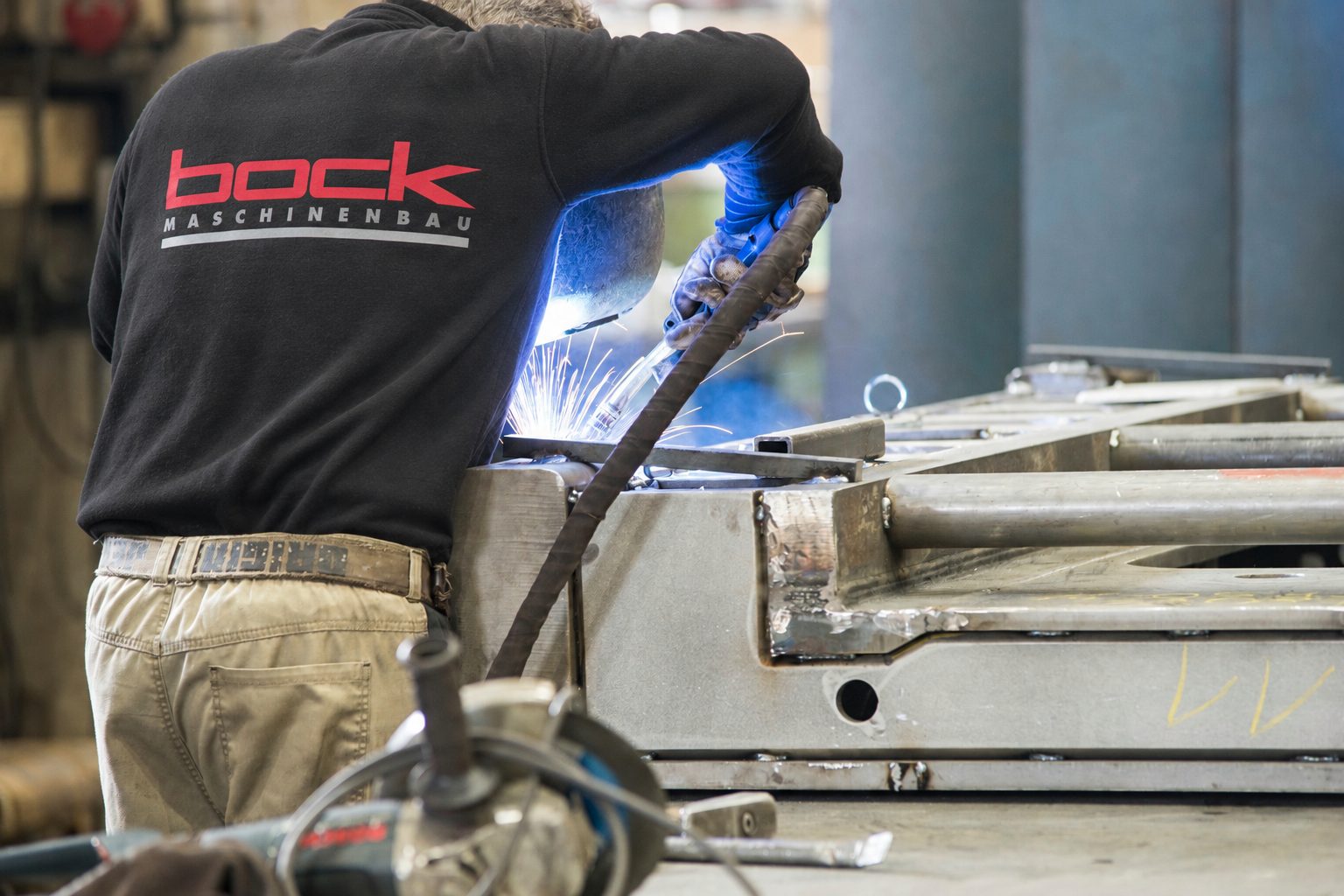
What a welder really does
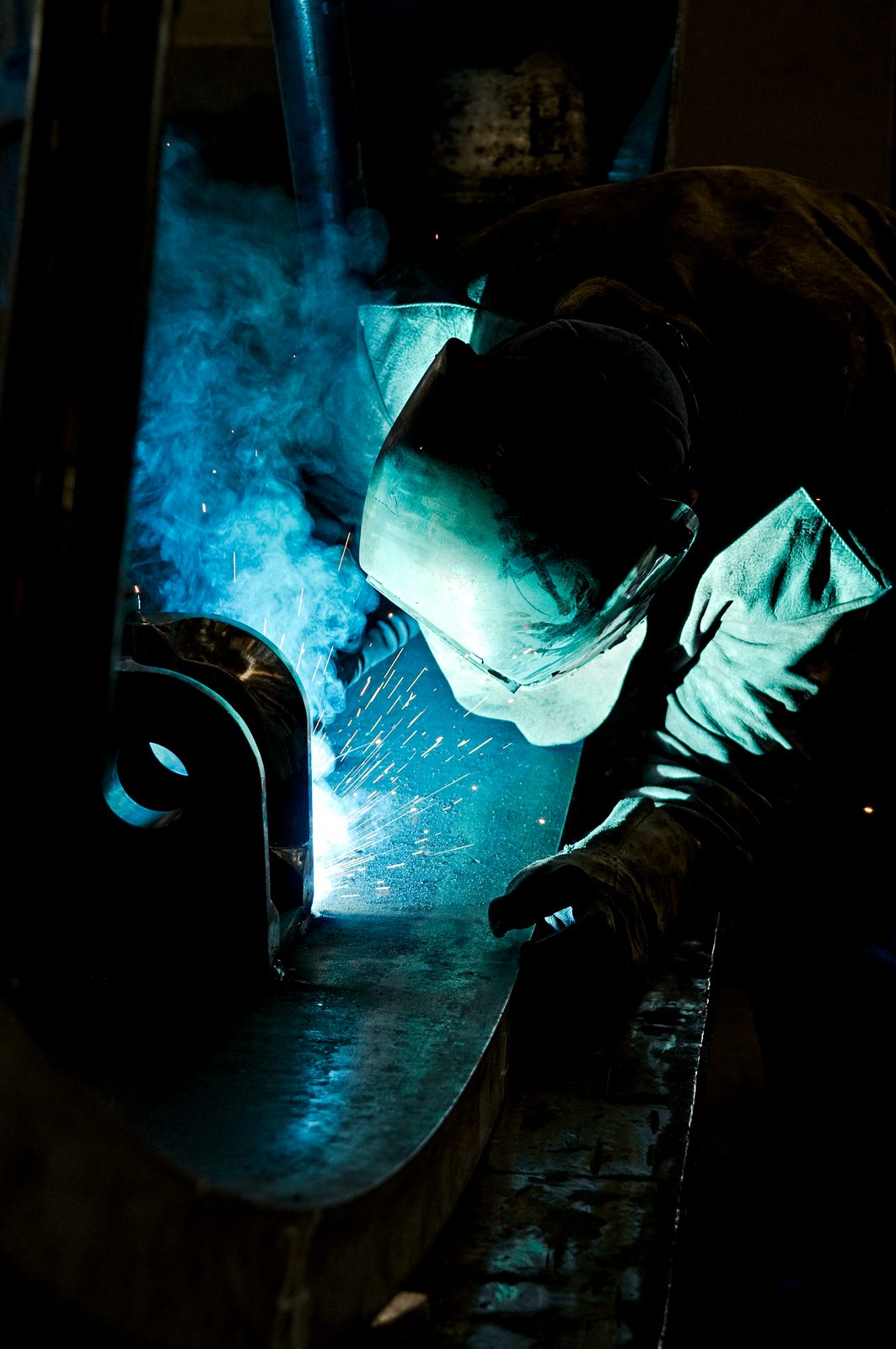
Most descriptions stop at one sentence: welders join metal parts permanently. That is true – and leaves out exactly what it is about. A weld is not a glued joint but a piece of the component that only comes into being at the moment of welding. What solidifies there has different properties from the plate next to it. Whether the structure holds is decided in these few millimetres.
In concrete terms, it starts like this: a tack-welded assembly from the fitting shop lies on the roller stand or the positioner. The drawing carries weld symbols – which type of weld, how thick, how long, all-round or intermittent. Next to it lies a second document that outsiders never get to see: the welding procedure specification. It defines the process, the filler metal, the current and the position in which welding is permitted.
The rest is decided by the welder – and that is more than it sounds. In which order the welds are laid so that the assembly does not pull together. Whether the part is turned so as to work in the flat position instead of overhead. Where a tack weld stays and where it is removed first. In this trade, heat is tool and adversary at the same time: it creates the joint and distorts the component in the process.
What comes afterwards is also part of the job: removing slag, looking at the weld, checking start and end craters, reworking wherever something is not right. Only then does the assembly move on – to inspection, to machining, to surface treatment. Whatever slips through here is found later by someone else, and by then a great deal more work has gone into the part.
What you weld here
That is the question no job advertisement answers – and the only one you talk about at home in the evening. Bock manufactures for fifteen industries, and that does not mean fifteen variants of the same part. Side by side on the stands lie:
- From crane construction: crane bridges and jibs – components that will later carry what others lift.
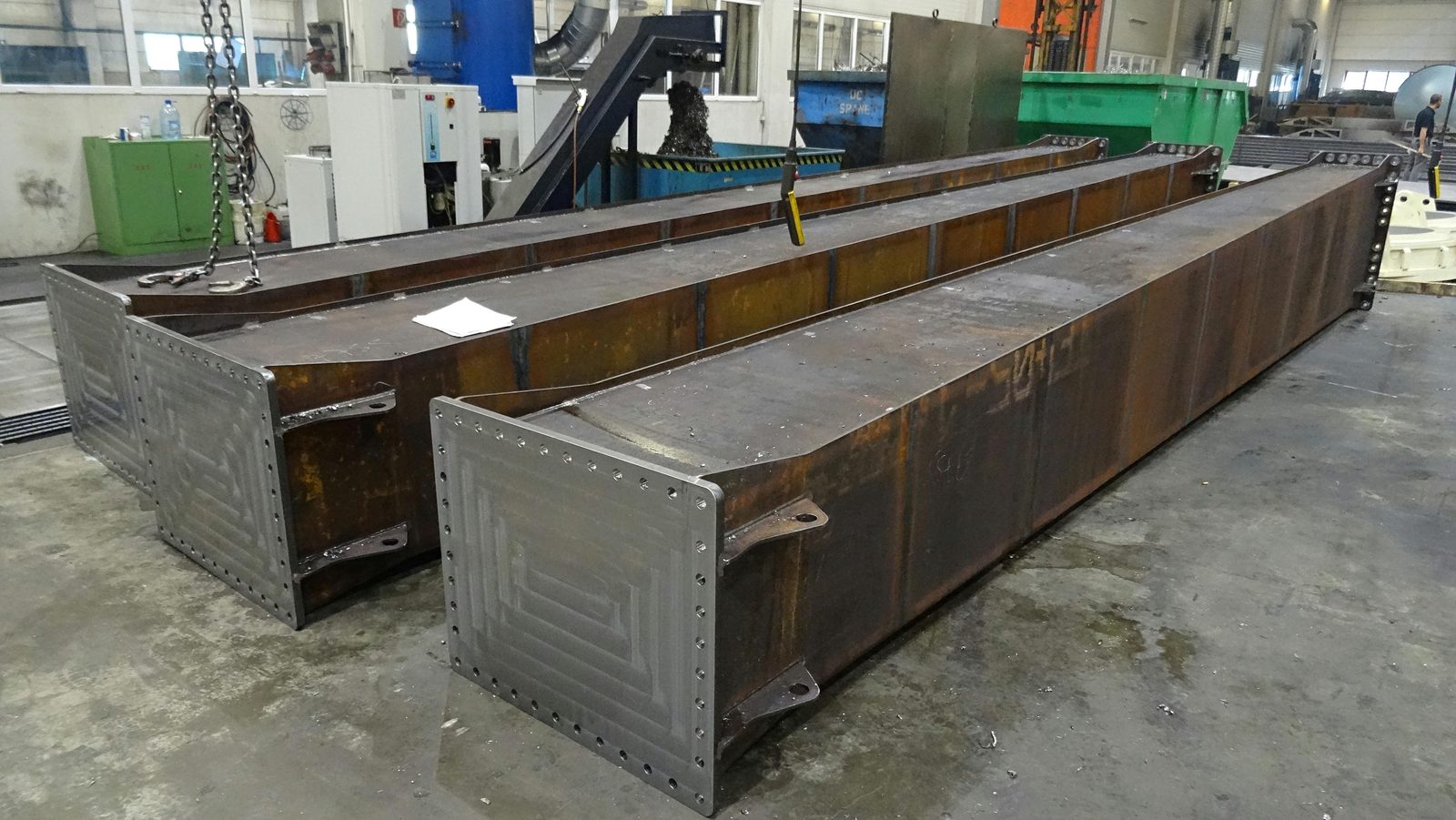
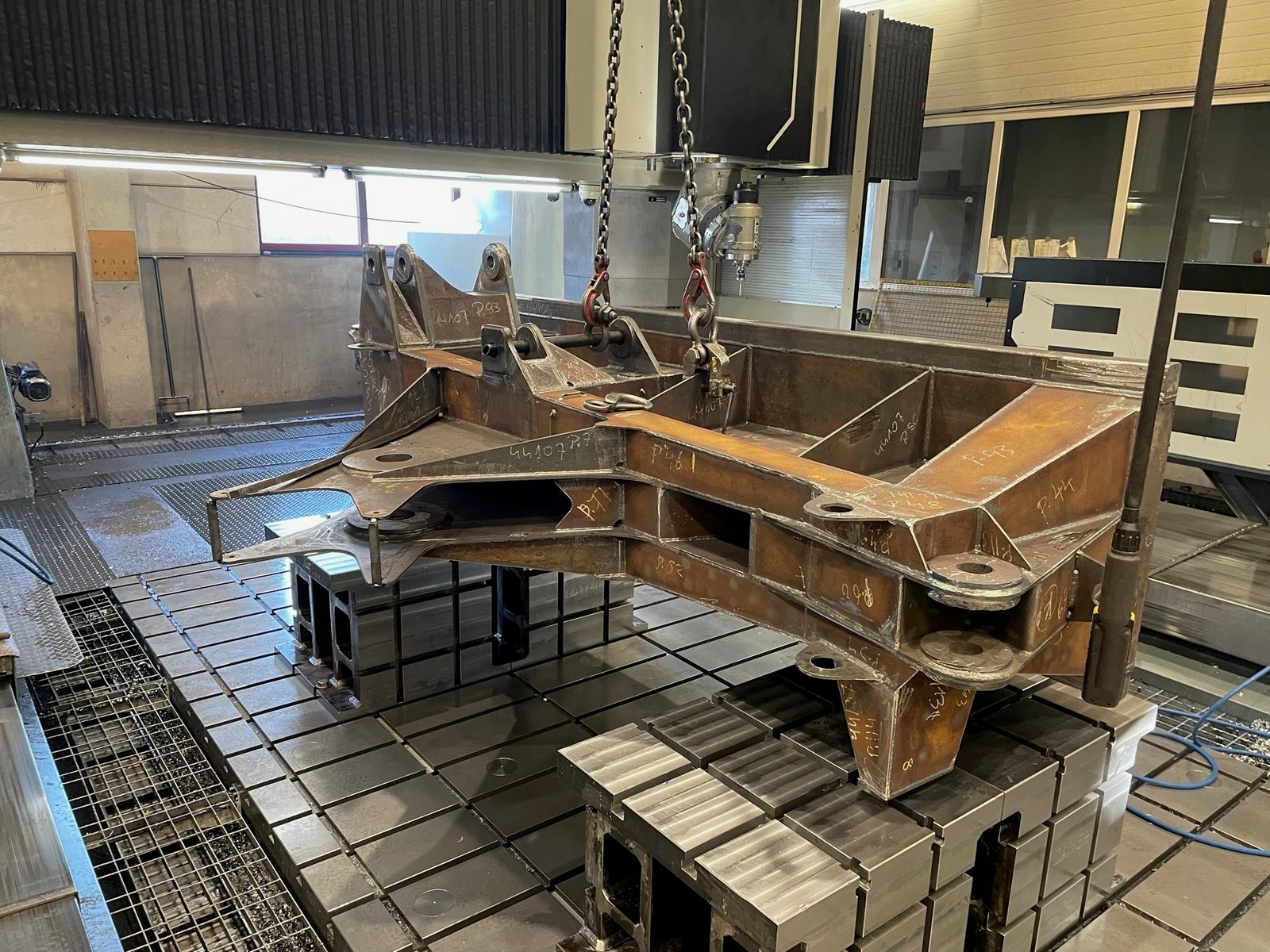
- From machine tool and press manufacturing: press frames, machine beds and base frames on which a complete plant will later stand.
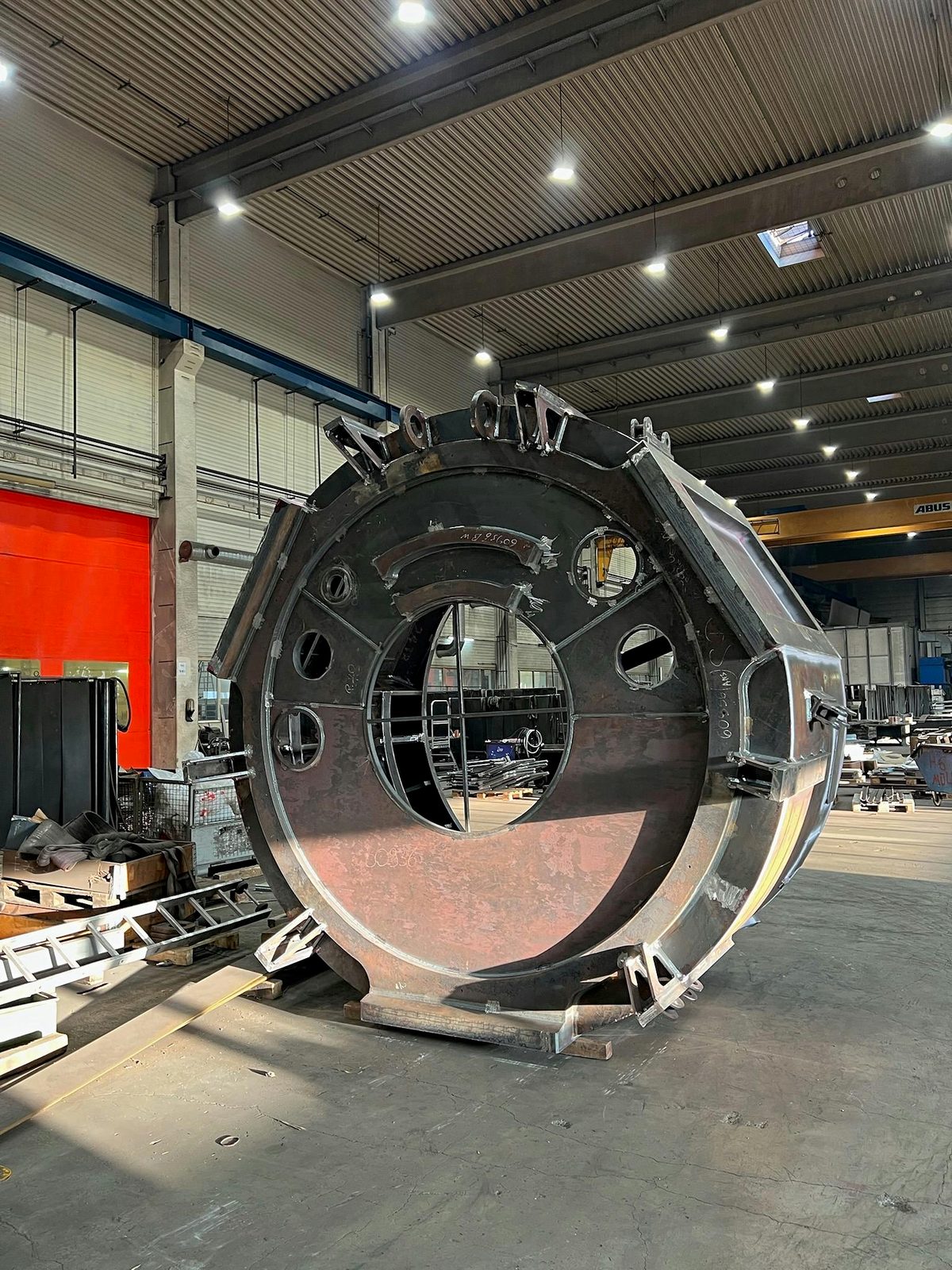
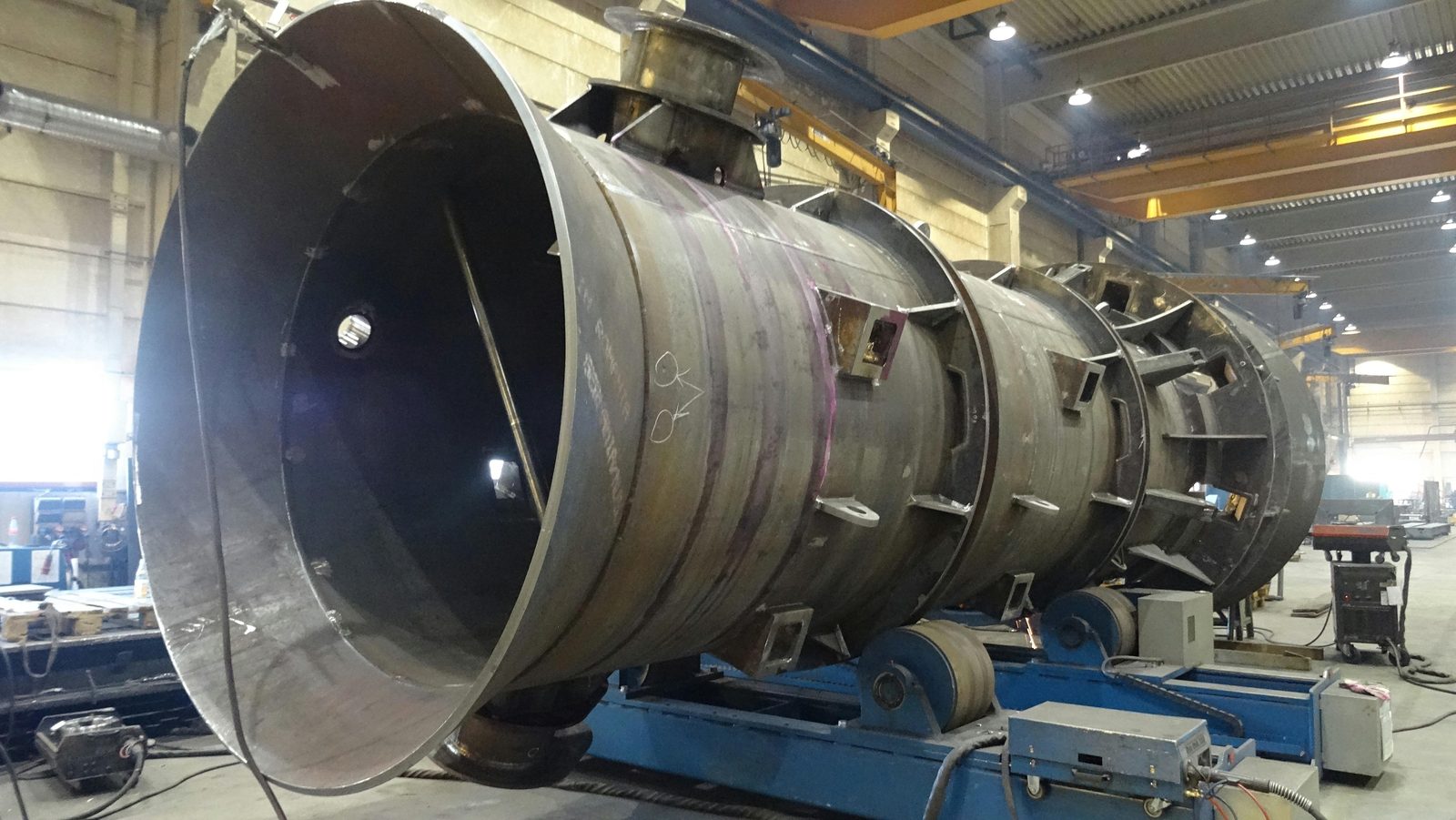
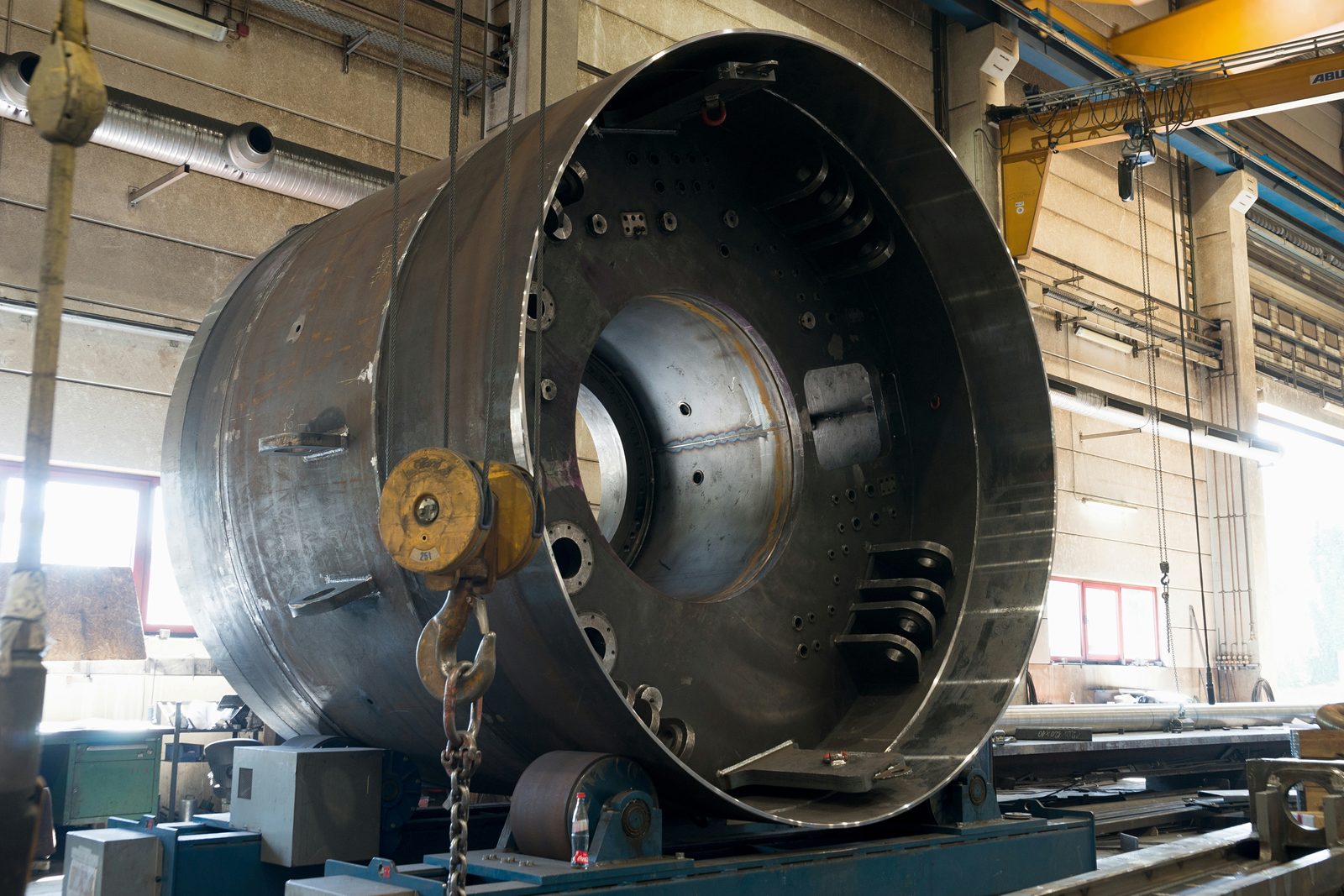
- From plant and apparatus engineering: pressure vessels and CrNi heat exchangers, large cylinders and drum shells to AD 2000 (the German pressure vessel code) – stainless steel, thinner walls, a different kind of care.
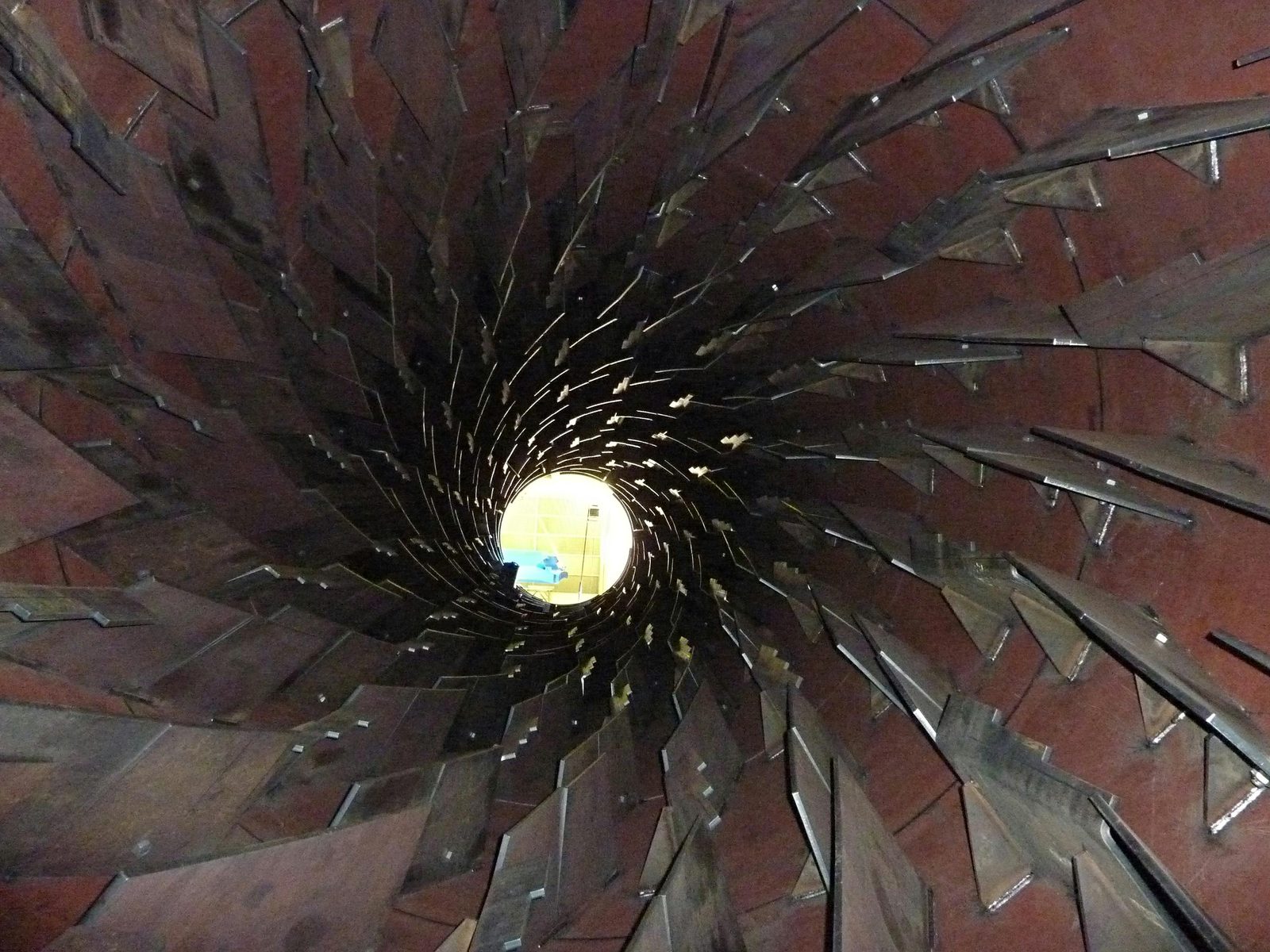
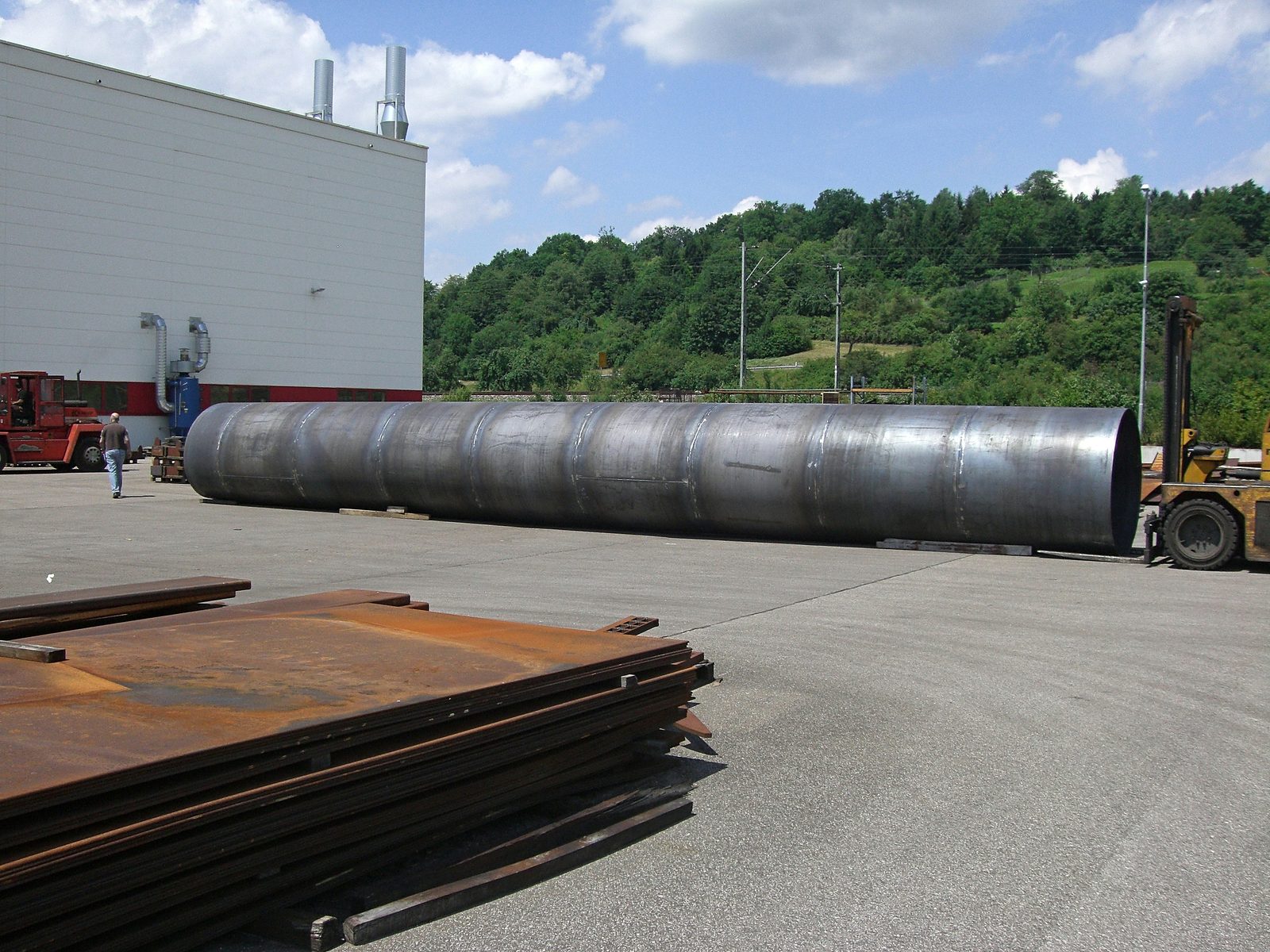
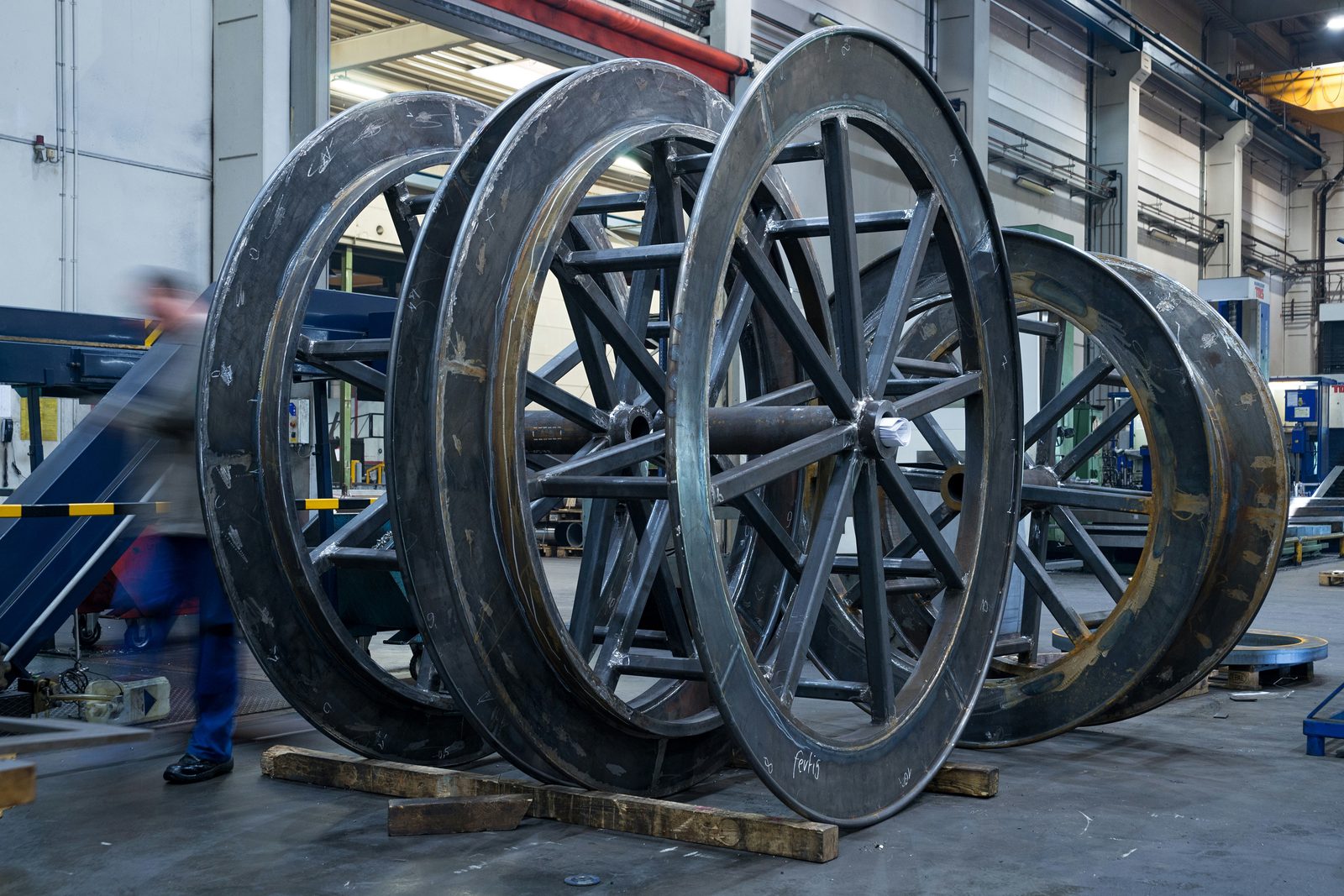
- From conveying technology: rope and grooved drums, screw conveyors for bulk materials, cones with radial blades – round parts where the weld runs around instead of straight ahead.
- From bridge construction, foundation engineering, offshore and hydraulic steel structures: truss girders, pipe sections and large pipes – welds that someone will stand on in the end.
And none of these parts ends up in a display case. They go into cranes and presses, power plants, bridges, offshore installations and foundation engineering – structures that have to last for decades outdoors and that nobody will touch up later. Anyone who laid a weld on them knows where it stands. On top of that, almost none of it comes a second time. Prototypes, batch size 1 and small series are the norm here, not the exception – and with the component, the material and the requirements change too: from structural steel S235/S355 through high-strength S690 to fine-grain structural steel S1100, plus wear-resistant steel such as Hardox, stainless steel 1.4301 to 1.4571, duplex 1.4462 and heat-resistant pressure vessel steels. Over 40 grades are kept in our own stock, every batch with an inspection certificate 3.1 to EN 10204. Anyone looking for variety gets it here not as a promise but as a production schedule.
MAG, TIG and submerged arc welding: how the work differs
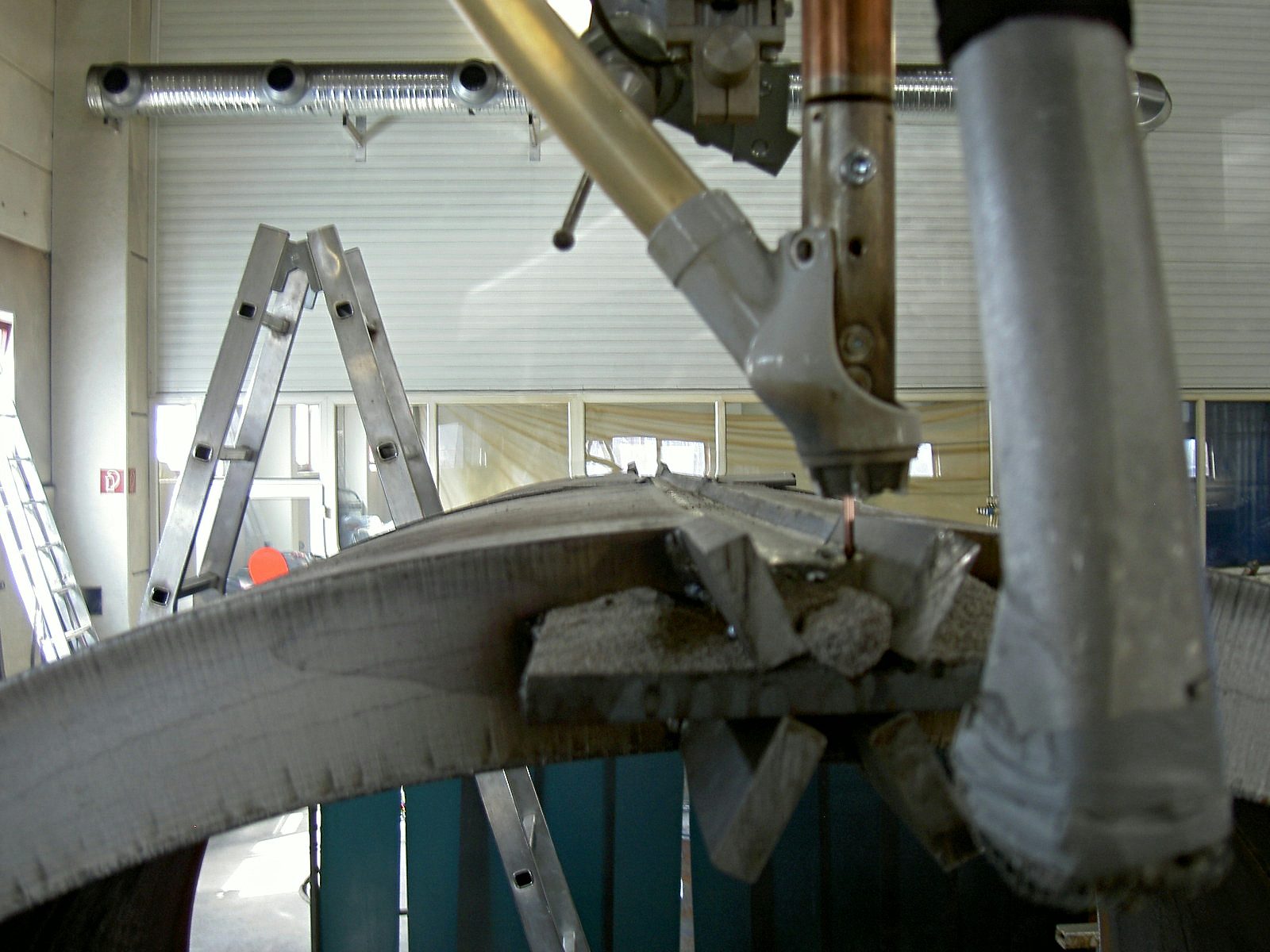
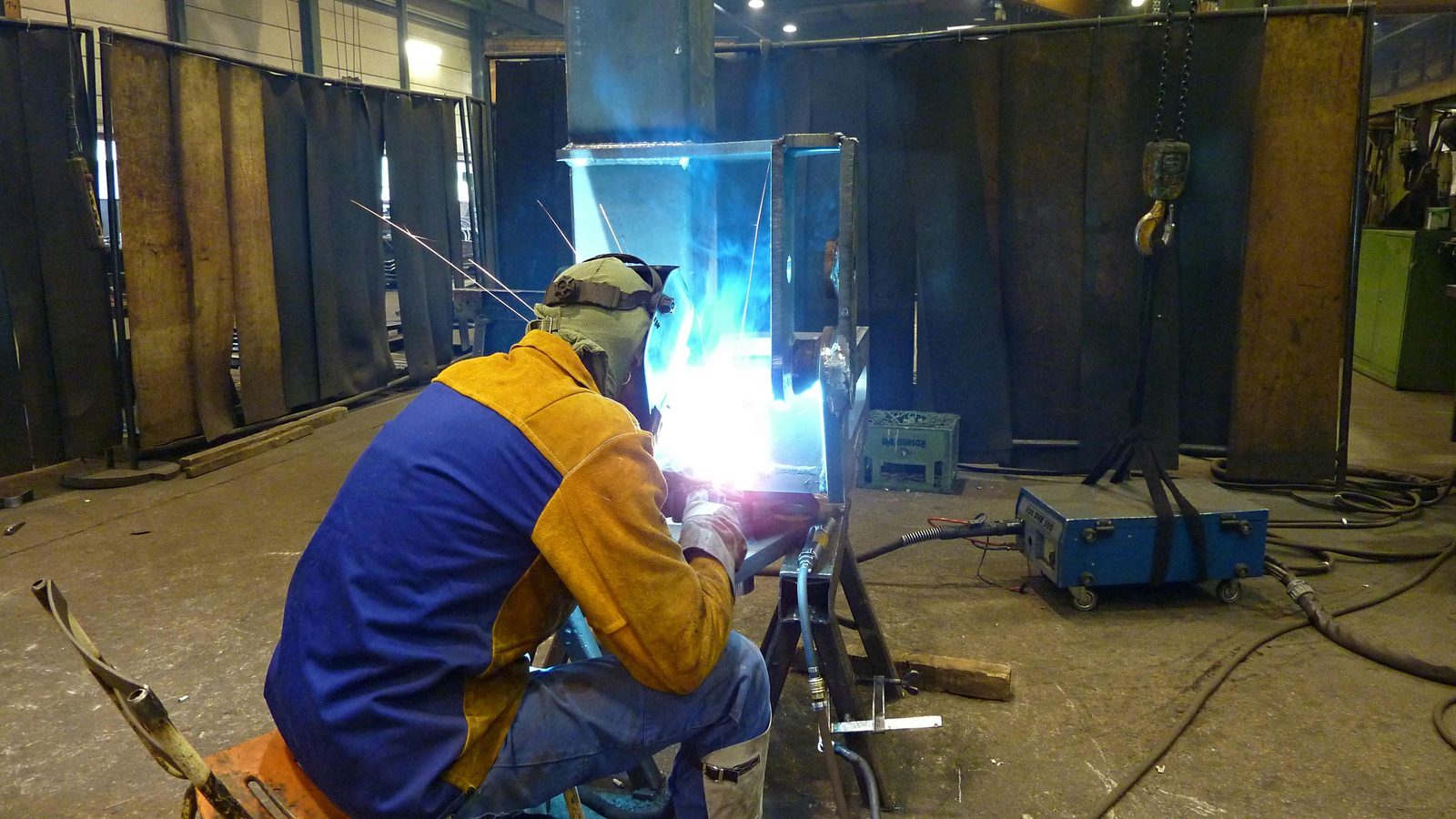
All three processes are available in-house, and each demands something different of the person operating it:
| Feature | MAG (135) | TIG (141) | Submerged arc (121) |
|---|---|---|---|
| How the arc is shielded | Active gas from the nozzle | Inert gas, filler metal fed by hand | A bed of flux covers the arc completely |
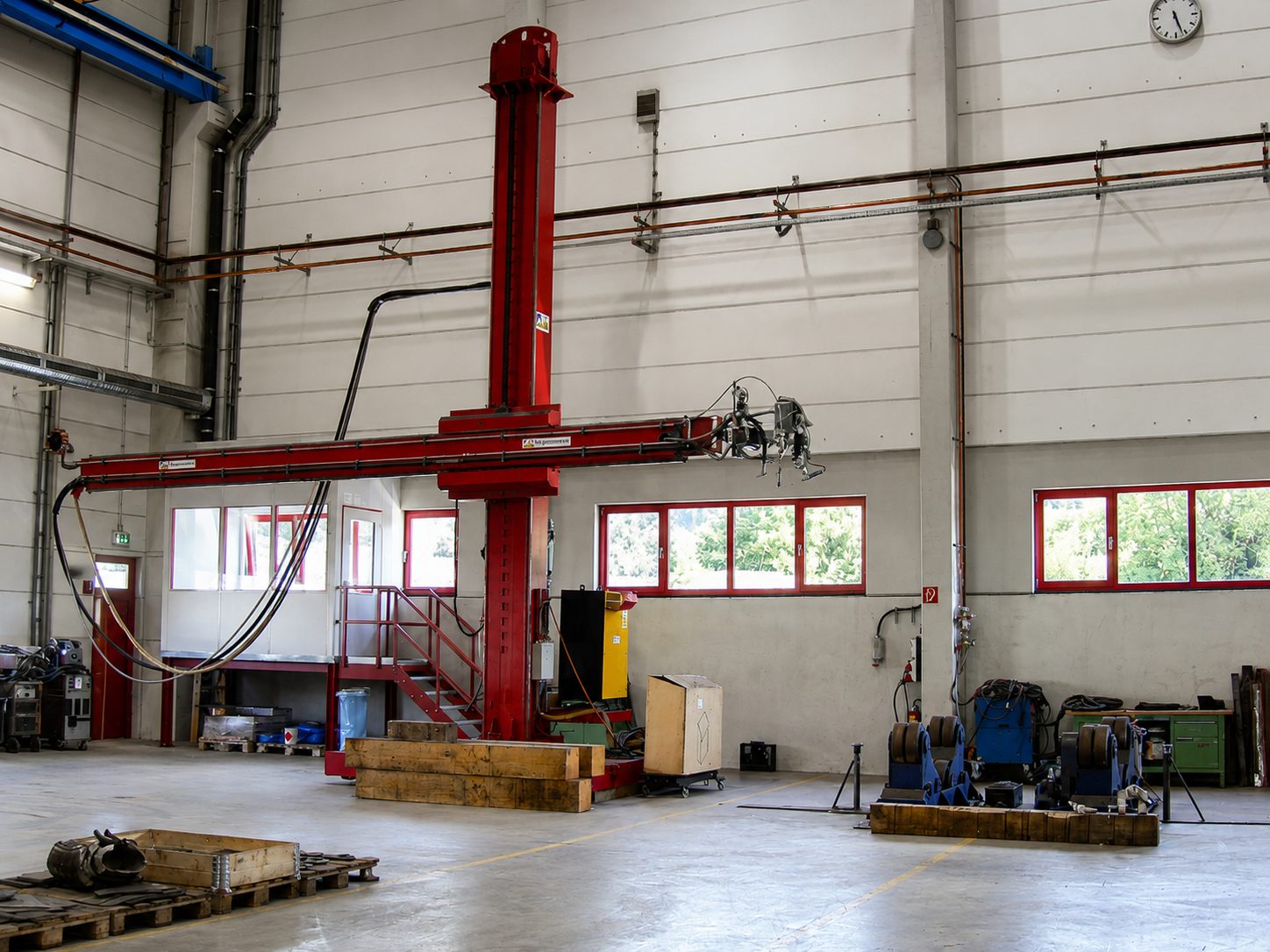
| What the welder guides | Torch and travel speed, mostly by hand | Torch in one hand, filler rod in the other | Not the hand but the system – the column and boom does the travelling |
| What it is used for here | Steel assemblies, frames, brackets – the bread-and-butter process | Stainless steel, special materials, high-quality joints | Long, thick welds on drums, pipes, girders |
| In-house equipment capacity | approx. 100 stations, approx. 600 A, wire up to 1.6 mm | Part of the same workstations | 3 column-and-boom units, up to 1,250 A, wire up to 4 mm |
| What the skill depends on | Mastering access and position | A steady hand, slow and clean work | Preparation: gap, position, parameters |
Rule of thumb: MAG is the speed, TIG the care, SAW the stamina. Anyone who can do all three is no longer assigned by process but by component.
Daily tasks: preparing, positioning, welding and checking
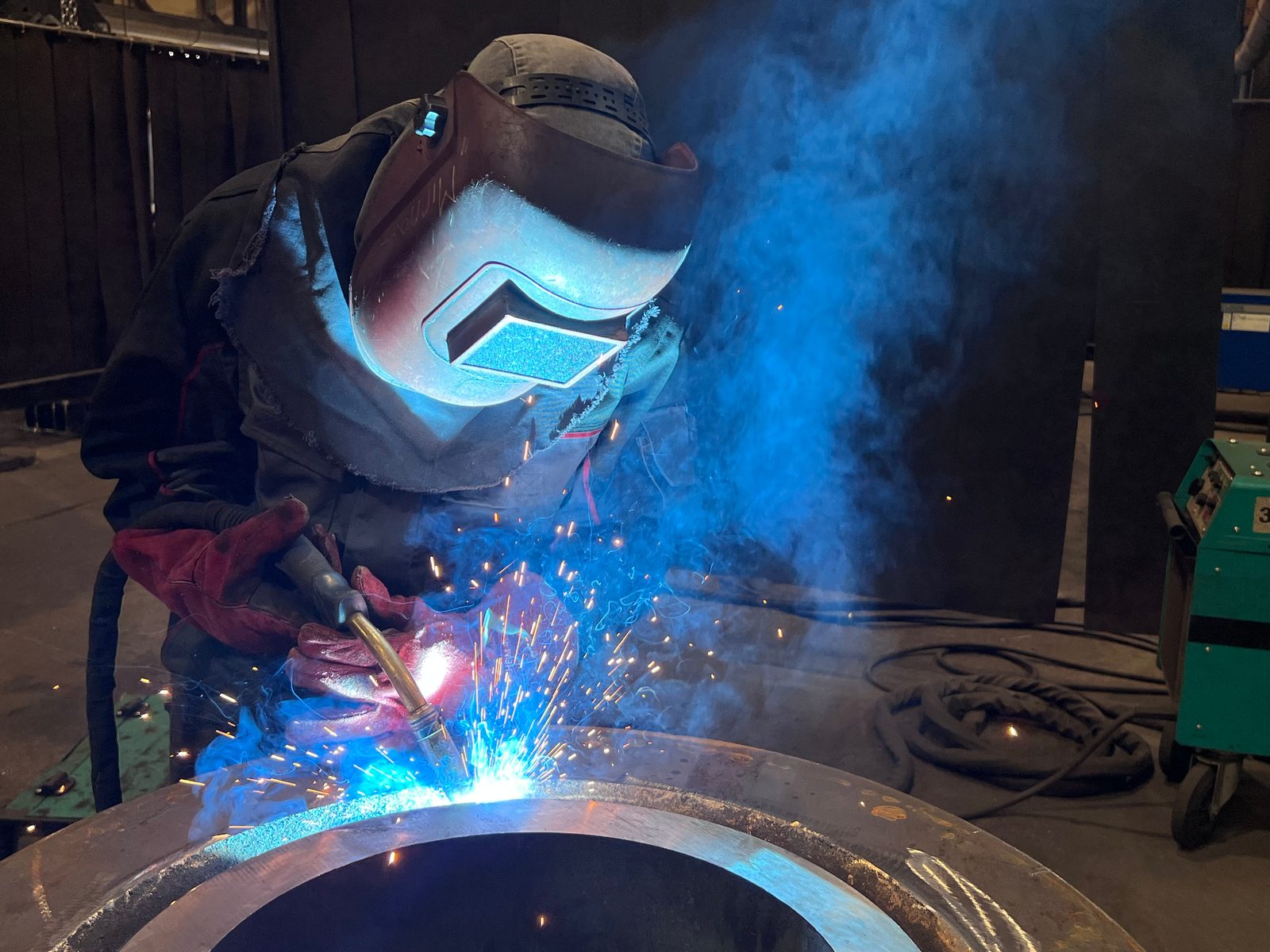
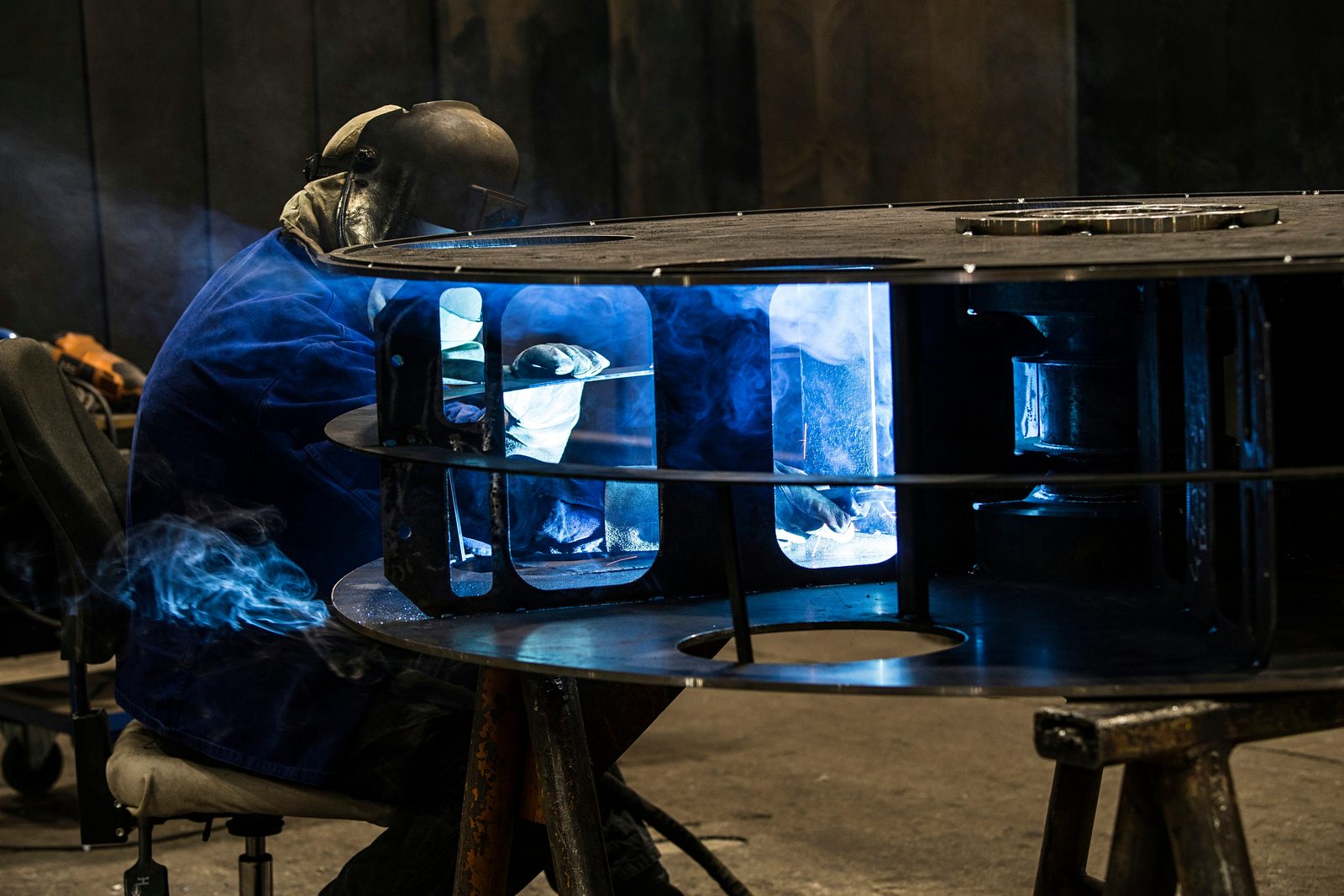
Anyone who knows the trade from watching thinks of someone with a helmet and a torch. That is the visible part. The rest looks like this:
- Preparing: cleaning joints, removing mill scale, rust and paint, checking gap dimensions. A weld is only as good as the condition of the joint – contamination is one of the most common causes of porosity.
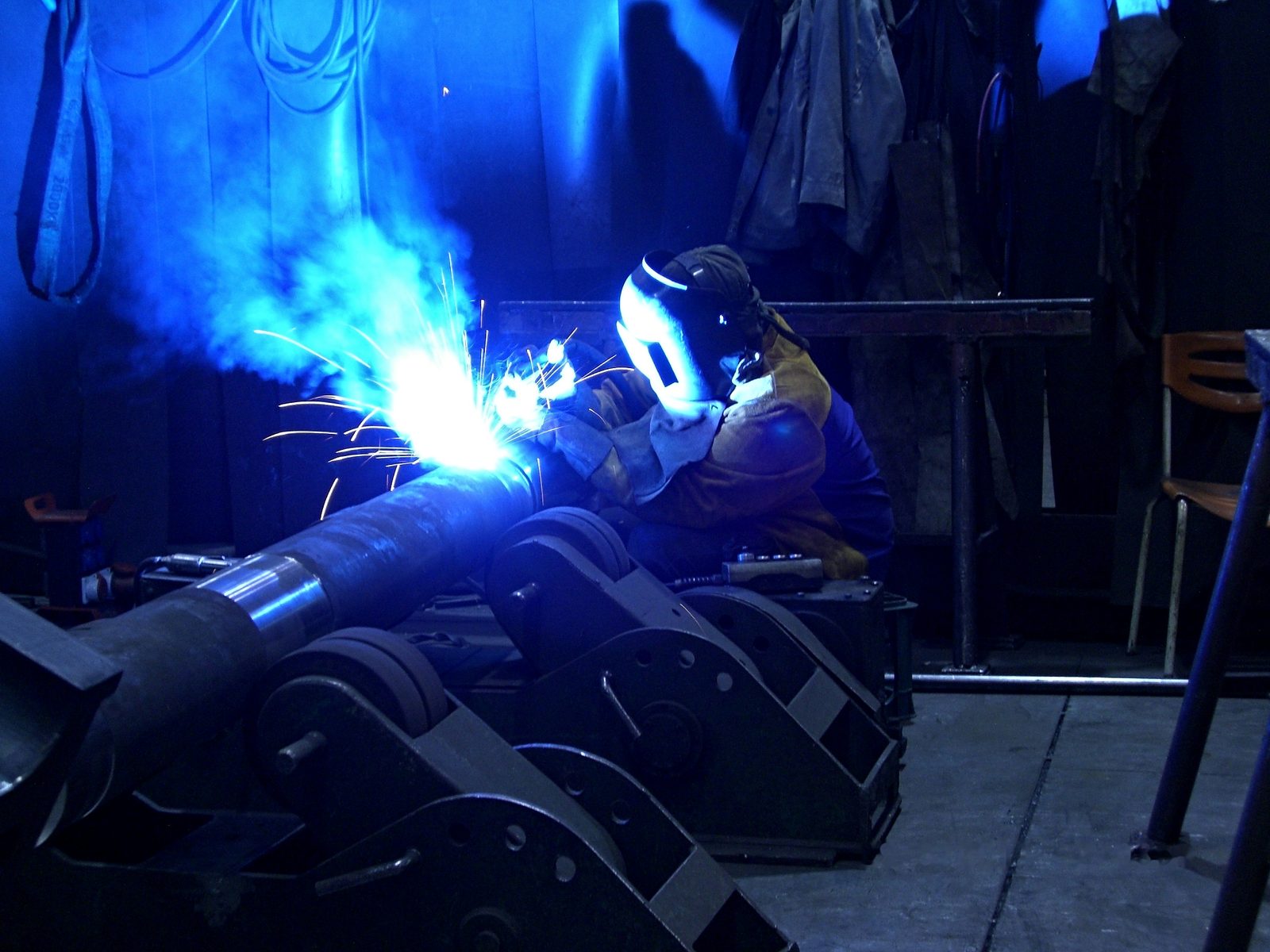
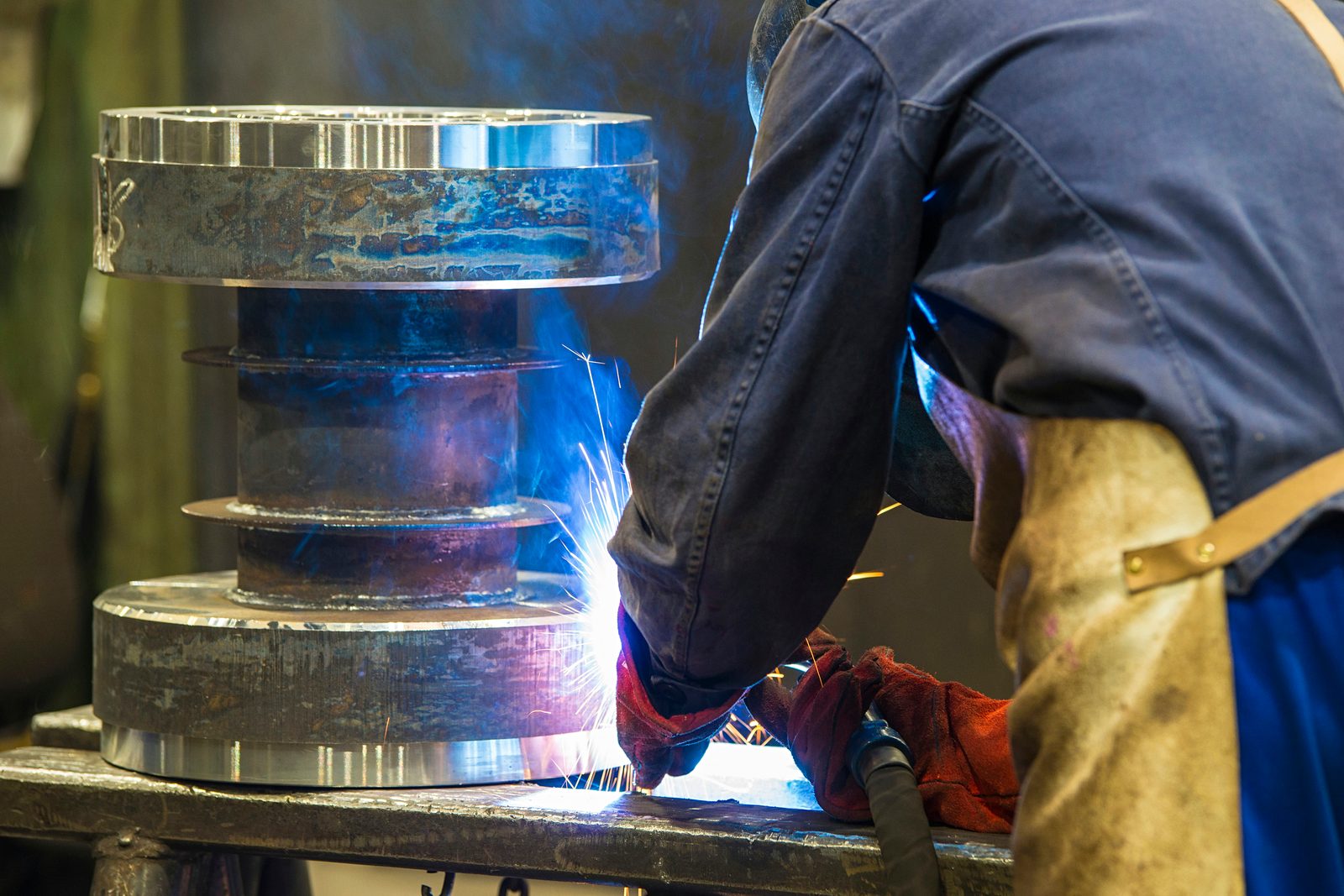
- Positioning: the assembly is turned so that welding can be done in the flat position wherever possible. Positioners up to 2,000 kg and six turning roll sets for Ø 150 to 7,500 mm and up to 60 t are available for this. Every repositioning costs time – and every one you skip although it would be necessary costs weld quality.
- Setting: current, wire feed, gas flow, weaving motion. The welding procedure specification sets the framework within which experience decides.
- Welding: on thick plates in multiple passes – root, fill passes, cap pass. Between the passes the weld is cleaned and the interpass temperature is watched, otherwise the microstructure suffers.
- Checking and attributing: visual inspection of your own weld, rework, and documentation of who welded which seam. In EXC3 production this is not a formality but part of the component.
What stands out is the share that does not look like welding: preparing, turning, setting, checking. This is exactly what distinguishes a qualified welder from someone who can lay a bead.
The welding procedure specification: instructions for the weld
A drawing defines the joint, but a welder also needs instructions for making it. The welding procedure specification, or WPS, sets out the process and parameters for the weld. DIN EN ISO 15609-1 defines the information it contains.
The WPS specifies the process, filler metal, weld build-up, current and voltage ranges, preheat and interpass temperatures, and welding position. Procedure qualification provides evidence for these choices. The associated records are called WPQRs (welding procedure qualification records), generally to DIN EN ISO 15614-1.
For the welder, the WPS provides a defined working range. Changing the wire, heat input or travel speed beyond that range needs to be resolved with welding coordination. Within it, the welder applies practical skill to a procedure whose suitability has already been established.
How binding this is can be found not only in the quality manual but in our Technical Terms of Delivery: work is carried out on the basis of valid welding procedure specifications, with validly qualified welders – and, depending on the degree of mechanisation, with qualified welding operators and weld setters.
Becoming a welder in Germany: training and qualification tests
In Germany, welding is generally entered through training in a metalworking trade or through vocational retraining, followed by qualifications for the welding work concerned. It is not a separate trade in the current dual apprenticeship system, which combines company training and vocational school. The former apprenticeship was called Schmelzschweißer (fusion welder). The main routes and requirements are:
- A metalworking trade as a foundation: Konstruktionsmechaniker (structural metal fitter), Metallbauer (metal fabricator), Industriemechaniker (industrial mechanic) – or vocational retraining as a welder. Our job advertisement lists both side by side, because both work.
- The welder qualification test to DIN EN ISO 9606-1: taken per process, material group, plate thickness and position. Anyone qualified for MAG in the flat position is not automatically permitted to weld overhead on a different material.
- Keeping an eye on validity: every six months the employer or the welding coordinator confirms on the certificate that the holder has continued to weld within the range of qualification – if the confirmation is missing, the qualification lapses. Revalidation follows one of three routes, which is fixed at the time of the test: a retest every three years, revalidation every two years based on two tested production welds, or no fixed deadline as long as the welder stays with the same company certified to EN ISO 3834-2 or -3 and that company documents the quality of their welds. For pressure equipment of category II and above, this third route is excluded (AD 2000-Merkblatt HP 3). At Bock, the SLV (Schweißtechnische Lehr- und Versuchsanstalt, the welding training and testing institute) of the DVS (German Welding Society) revalidates the qualifications in good time before they expire – the company bears the costs. Unlike most trades, a welder therefore manages a personal bundle of certificates.
- Experience with the material: structural steel behaves differently from fine-grain steel up to S1100, wear-resistant steel differently from stainless steel. Knowing which of them requires preheating does not come from a textbook.
- Additional qualification for the equipment: in submerged arc welding, what counts is not guiding the torch by hand but setting up the system – this is what the welding operator qualification is for.
Applicants do not need to arrive with every qualification already in place. Our vacancy lists valid welder qualifications as desirable, alongside relevant training and experience. The application is an opportunity to discuss existing skills and any further qualifications needed.
How to read a welder qualification certificate
A welder qualification certificate defines a specific range of work. Its abbreviations record the tested process and conditions, helping both the welder and the employer check whether a qualification covers the intended joint:
| Field on the certificate | What it specifies | Example |
|---|---|---|
| Process | Which welding process was tested – as a reference number to DIN EN ISO 4063 | 135 = MAG · 141 = TIG · 121 = submerged arc |
| Product form | Whether the test was on plate or on pipe | P = plate · T = pipe |
| Weld type | Butt weld or fillet weld – each is tested separately | BW = butt weld · FW = fillet weld |
| Material group | Which group of steels the certificate covers | Structural steel, fine-grain steel and stainless steel are not interchangeable |
| Dimensions | The thickness and diameter range it covers | t = test piece thickness · D = pipe diameter |
| Position | Which welding position was tested – each has its own range of qualification | PA = flat · PC = horizontal · PF = vertical up |
| Weld details | Whether welding was done from one side or both sides, with or without weld backing | ss = single side · nb = no backing |
| Validity | How long the certificate runs and how it is confirmed | Confirmation every 6 months · revalidation after 2 or 3 years or continuously in a certified company |
Rule of thumb: the certificate does not say that someone can weld, but what they are qualified to weld – and until when. That is why a welder collects several of them over the years rather than a single one.
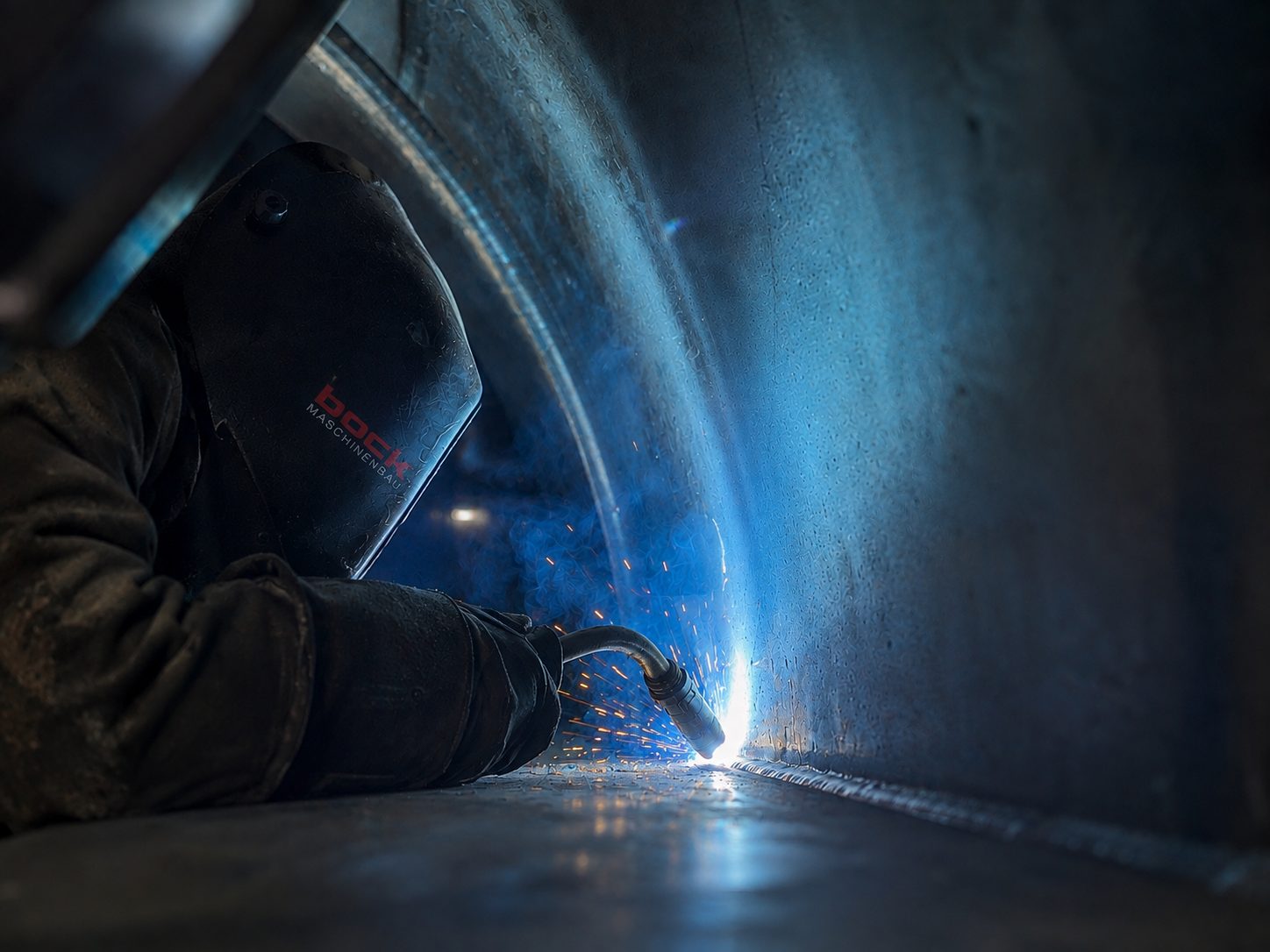
What EXC3 means for day-to-day welding work
DIN EN 1090-2 defines four execution classes. EXC1 is sufficient where a failure has limited consequences; EXC3 applies to structures where the stakes are serious. Our company is certified for EXC3 – together with EN ISO 3834-2, the comprehensive quality requirement for welding companies, both certified by DVS ZERT. For apparatus engineering, AD 2000 HP 0 is added, certified by GSI SLV.
The difference in day-to-day work is not the helmet and not the torch, but what happens around the weld. There is welding coordination that is responsible for what gets welded – at our company, personnel qualified as International Welding Engineer (IWE) and International Welding Specialist (IWS). There are inspection scopes that are fixed in advance. And every weld is attributed to a person.
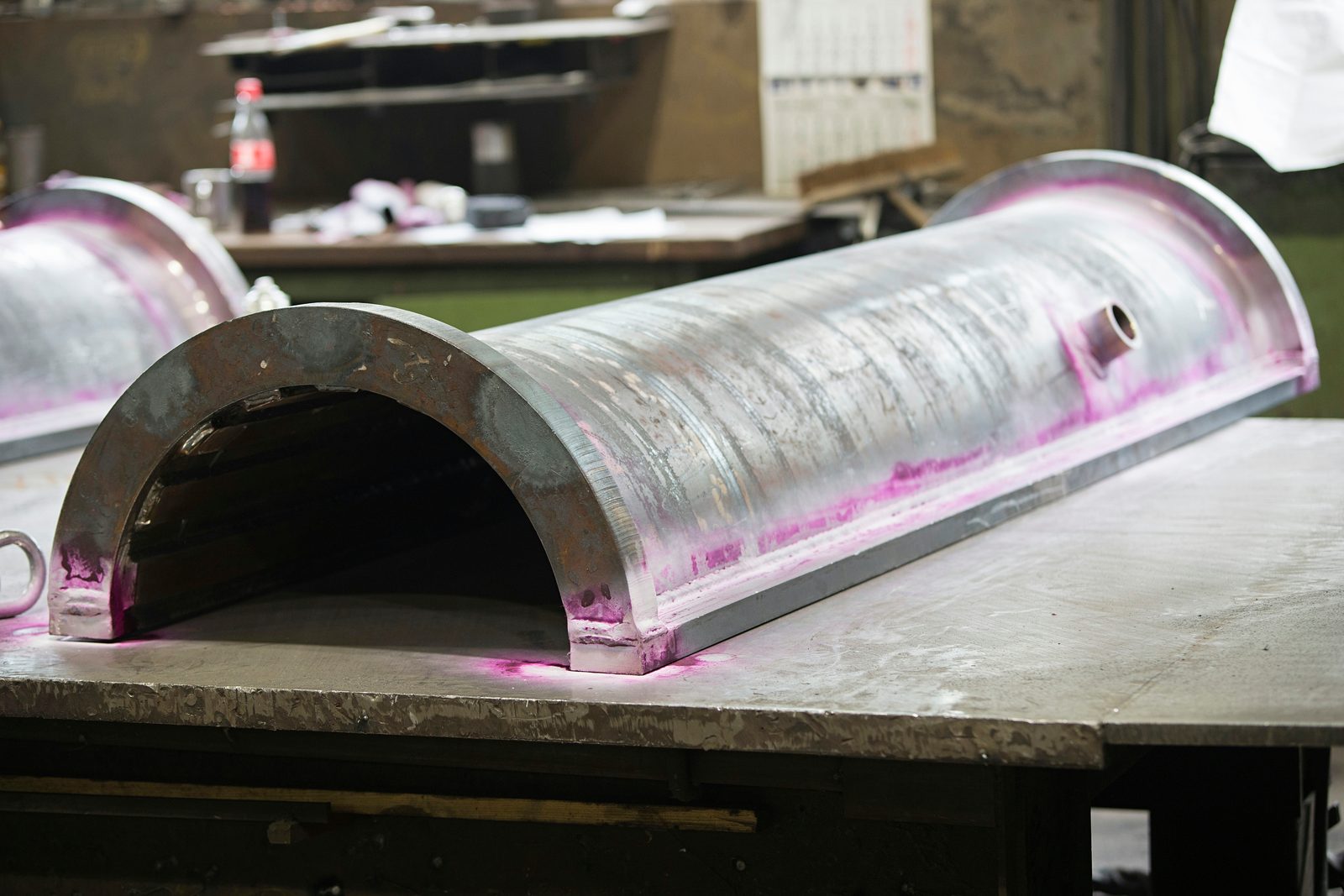
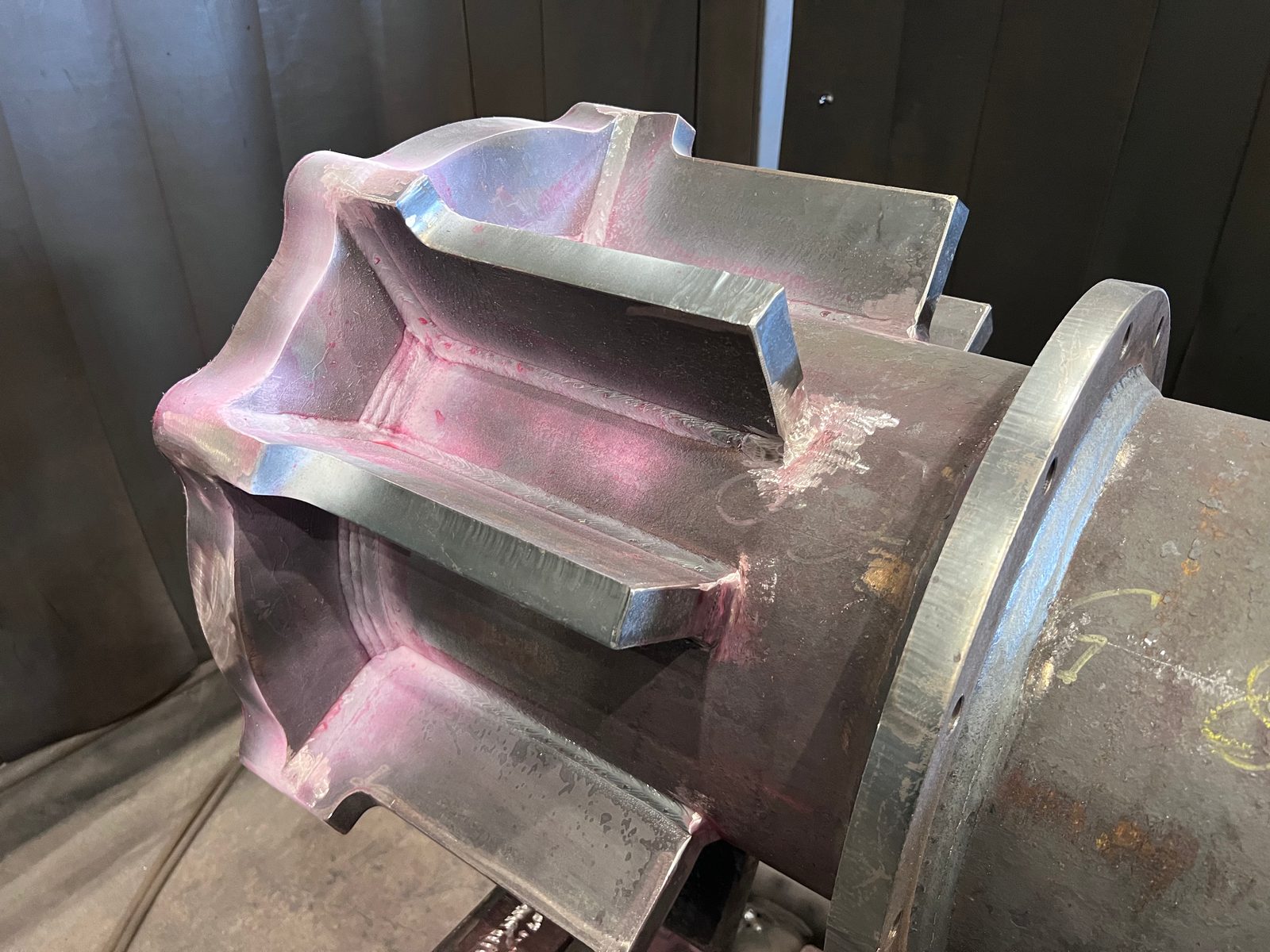
Visual testing (VT), dye penetrant testing (PT) and magnetic particle testing (MT) are carried out in-house by personnel qualified to DIN EN ISO 9712. For the welder, this provides an independent assessment and a documented result against defined requirements.
Appearance alone cannot establish weld quality. Lack of fusion and porosity can lie beneath a sound-looking surface; the guide to weld testing methods explains how different techniques detect them. Weld profile, heat input, inspection results and documentation all contribute to assessing the finished joint.
Weld testing methods: which one is needed?
A surface crack and an internal flaw need different tests. Compare VT, PT, MT, ET, UT and RT, and learn what a useful inspection specification must include.
Compare testing methodsBefore and after welding: the production chain at Bock
A weld is never made in isolation. At Bock, the steps before and after it take place on 14,000 m² under the same roof:
- Before it, cutting: oxy-fuel flame cutting up to 200 mm and CNC plasma cutting, plus bevel cutting and edge milling for weld preparation. Anyone who gets the joint they need welds faster and better.
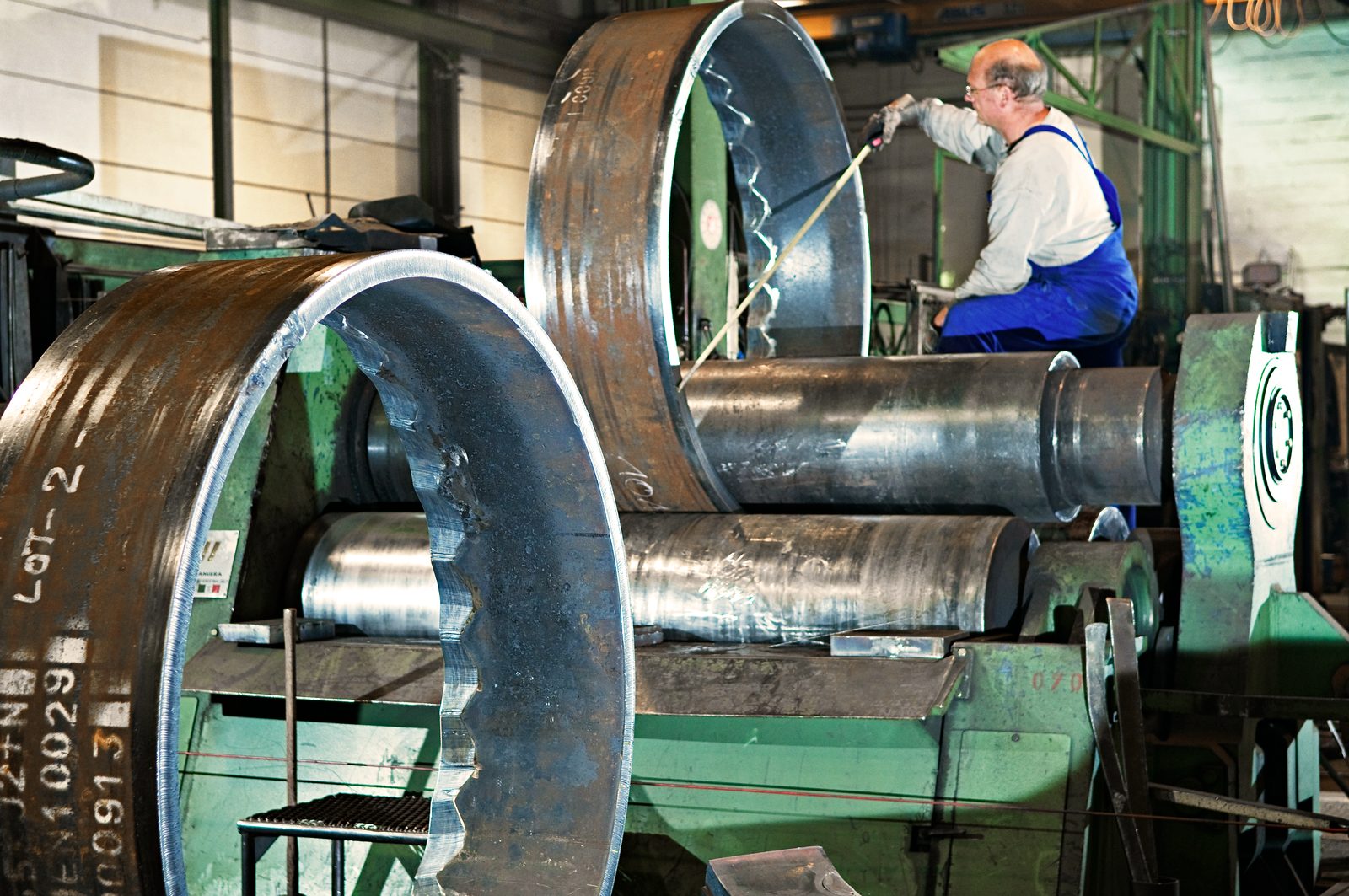
- Before it, forming and the fitting shop: rolled shell courses, press-braked plates, tack-welded assemblies. If a gap dimension is wrong, the welder is the first to notice – and the short walk to the colleague replaces a formal complaint here.
- Alongside it, handling: the 2 × 25-t crane for components up to 50 t, roller stands up to 60 t, positioners. Slinging and turning loads is part of the work in this trade, not a side job.
- After it, stress relief: vibration stress relief and flame straightening recover what the heat has distorted – a firmly scheduled step, not a repair.
- After it, machining: mating surfaces are deliberately produced after welding so that the distortion from the weld stays outside the dimensional chain. Components up to 26 m in length are machined.
For the trade, this is the decisive difference from a pure welding shop: you see where the part comes from and what happens to it afterwards. And you weld differently when you know that in four weeks someone will mill a mating surface into exactly this assembly.
Physical demands, rules and responsibilities to consider
Welding combines concentration, physical demands and responsibility for a documented result. These aspects are worth considering before entering the trade:
- Working conditions: heat, fumes, noise and awkward positions are part of welding. Extraction, protective equipment and positioners reduce exposure and strain, though some physical demands remain.
- Defined procedures: welding procedure specifications, inspection requirements and records guide the work. In EXC3 production, following them is part of making the joint correctly.
- Continued learning: qualifications need to be maintained, and new materials or processes bring new requirements. Developing these skills expands the range of work available.
- Inspection after welding: the appearance of the bead gives only part of the picture. Non-destructive testing may confirm the result later in the production sequence.
- A focus on the joint: welders complete the connections in an assembly. Those more interested in fitting and aligning the whole structure may prefer structural metal fitting, the German Konstruktionsmechaniker trade.
Structural metal fitter: tasks, training and career paths
How do separate steel parts become an accurately fitted machine frame? A look at the work, judgement and German training route behind structural metal fitting.
Explore the tradeCareer paths after the first qualification test
Development only begins with the first passed welder qualification test. The most obvious path is breadth: more processes, more material groups, more positions. Every additional valid qualification widens the range of components someone can be deployed on – and in a company that mostly builds one-offs, that is a tangible difference.
The second path leads away from manual torch guidance. Submerged arc welding is not guided by hand but set up and operated. Three column-and-boom units are available for this, the largest with 7 m reach, 7 m working height and up to 1,250 A with wire diameters up to 4 mm. Anyone who masters these systems works on the long welds that nobody would lay economically by hand.
The third path leads into responsibility: welding coordination, quality assurance, non-destructive testing. The qualifications for this – IWS, IWE, testing levels to ISO 9712 – are available here in the company and not in the organisation chart of a distant headquarters.
What ends up on the payslip depends on concrete things: on valid qualification tests, on the processes someone masters reliably, and on the responsibility they take on. That is why we do not state a flat figure – pay is based on qualification, professional experience, area of work and individual agreement. There is no shift work for welders at our company. Independently of this, the same benefits apply to everyone in the company, from the company pension scheme to the travel allowance; they are listed on the Careers at Bock page, in a family business with 63 years of manufacturing experience.
Steel construction apprenticeships: which trade suits you?
Follow a component through the workshop to discover the work of fitters, machinists and welders, and how German apprenticeships prepare people for these roles.
Explore apprenticeshipsWelding work in pictures
Revisit the workshop images from this article. Select an image to return to its chapter.
-
The trade -
1 What a welder really does -
2 What you weld here -
2 What you weld here -
3 MAG, TIG and submerged arc welding: how the work differs -
3 MAG, TIG and submerged arc welding: how the work differs -
4 Daily tasks: preparing, positioning, welding and checking -
4 Daily tasks: preparing, positioning, welding and checking -
5 The welding procedure specification: instructions for the weld -
6 Becoming a welder in Germany: training and qualification tests -
7 How to read a welder qualification certificate -
8 What EXC3 means for day-to-day welding work -
9 Before and after welding: the production chain at Bock -
9 Before and after welding: the production chain at Bock -
10 Physical demands, rules and responsibilities to consider -
11 Career paths after the first qualification test -
11 Career paths after the first qualification test
Frequently asked questions about working as a welder
What does a welder do?
A welder joins plates, pipes and sections into assemblies using a specified welding process. The job includes preparing the joint, positioning the component, following the welding procedure specification and checking the completed weld. Qualifications define the processes and conditions the welder is qualified to work with, typically under DIN EN ISO 9606-1 for steel. In Germany, welding is usually entered through a metalworking trade or vocational retraining rather than a separate dual apprenticeship.
Is welding a separate apprenticeship trade in Germany?
Germany’s current dual apprenticeship system does not have a separate welder trade. Common routes are a metalworking apprenticeship or vocational retraining, followed by welder qualifications to DIN EN ISO 9606-1. Our vacancy recognises welding training and related metalworking qualifications; valid welder qualifications are desirable. Experience with steel assemblies and careful working practices also matter.
Which welding processes should I already know?
We weld MAG on steel assemblies and special machines, TIG for high-quality joints and special materials, and submerged arc on fully mechanised systems. Nobody needs to bring all three. Anyone who has a sound command of MAG will find work here – and learns the others on the job.
How long is a welder qualification test valid?
Under DIN EN ISO 9606-1 it has to be confirmed every six months by the employer or the welding coordinator. It is revalidated by one of three routes: a retest every three years, every two years based on two tested production welds, or with no fixed deadline as long as the welder works for the same company certified to EN ISO 3834-2 or -3 and that company documents the quality of their welds – except for pressure equipment of category II and above. At our company, the SLV of the DVS revalidates the qualifications in good time before they expire, and Bock bears the costs. The often-quoted “two years” comes from the predecessor standard EN 287-1. And if your qualification has expired: apply anyway – what matters more is which processes, materials and positions you actually master.
Do I work overhead all day?
No, and that is above all a question of equipment. Assemblies are turned into a favourable position as far as possible: positioners up to 2,000 kg, six turning roll sets for Ø 150 to 7,500 mm and up to 60 t, plus the 2 × 25-t crane. Awkward positions cannot always be avoided – but here they are the exception and not the rule.
What does a welder earn at Bock?
We deliberately do not state a figure that applies to everyone: valid qualification tests, mastered processes and responsibility taken on are distributed very differently, and that is exactly what pay depends on – alongside qualification, area of work and individual agreement. The benefits that apply to everyone regardless are listed on the careers page.
Where exactly is the workplace?
In 73547 Lorch in the Ostalbkreis, near Schwäbisch Gmünd. The welding shop is under the same roof as cutting, the fitting shop and machining, and the distances between the trades are short. The site can also be reached from Schorndorf, Aalen, Göppingen and Stuttgart; there is an allowance towards travel costs.
How does a welder’s role differ from structural metal fitting?
A structural metal fitter aligns, fits and tack-welds the assembly; the welder completes its load-bearing joints. In Germany, the fitter apprenticeship is called Konstruktionsmechaniker and is a common route into welding. Welder qualifications then cover the particular processes, materials and conditions required for the work.
Sources and standards
Standards are cited with number and edition; their text is subject to a charge and is therefore not linked. The linked sources were accessed and read on the date stated.
- Schmelzschweißer as an apprenticeship trade until the mid-1990s; third revalidation route excluded for pressure equipment of category II and above (AD 2000-Merkblatt HP 3) J. Mußmann: 100 Jahre Schweißerprüfung, 10 Jahre ISO 9606-1 – Ein Erfahrungsbericht (100 years of welder testing, 10 years of ISO 9606-1 – a report from practice)
- Confirmation every six months, validity and revalidation Tests to DIN EN ISO 9606-1
- The three revalidation routes and their conditions Orientierung über die Schweisserprüfung nach EN ISO 9606-1, Abschnitt 13 (guidance on the welder qualification test to EN ISO 9606-1, section 13)
- Welder qualification test and welder's certificate DIN EN ISO 9606-1 – Qualification testing of welders – Fusion welding – Part 1: Steels
- Reference numbers 135, 141 and 121 DIN EN ISO 4063 – Welding, brazing, soldering and cutting – Nomenclature of processes and reference numbers
- Welding procedure specification (WPS) DIN EN ISO 15609-1 – Specification and qualification of welding procedures – Welding procedure specification – Part 1: Arc welding
- Welding procedure test (WPQR) DIN EN ISO 15614-1 – Specification and qualification of welding procedures – Welding procedure test – Part 1: Arc and gas welding of steels
- Execution classes EXC1 to EXC4 DIN EN 1090-2 – Execution of steel structures and aluminium structures – Part 2: Technical requirements for steel structures
- Comprehensive quality requirements for welding companies DIN EN ISO 3834-2 – Quality requirements for fusion welding of metallic materials – Part 2: Comprehensive quality requirements
- Qualification of testing personnel (VT, PT, MT) DIN EN ISO 9712 – Non-destructive testing – Qualification and certification of NDT personnel
- Inspection certificate 3.1 DIN EN 10204 – Metallic products – Types of inspection documents