The largest word clock in the world: we made its Corten steel front panel
Contents
From designer clock to large steel fabrication project
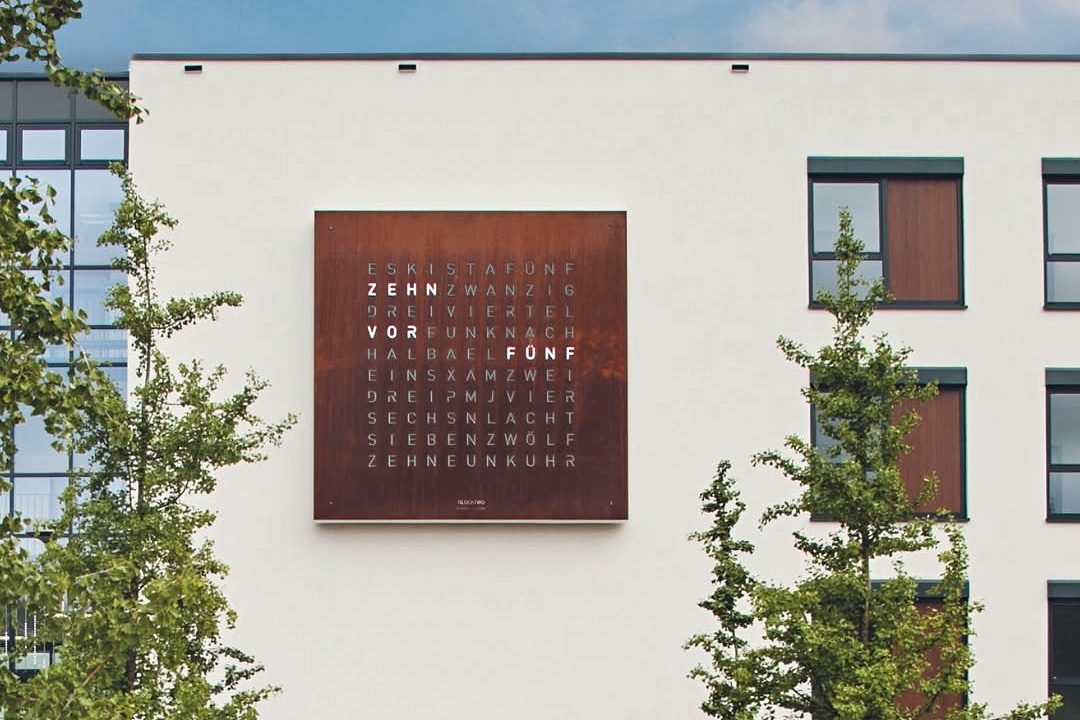
The QLOCKTWO by the Schwäbisch Gmünd designers Marco Biegert and Andreas Funk has no hands and no numerals. It lights up letters and writes the time as a sentence – "ES IST ZEHN VOR FÜNF" (it is ten to five). It is built in the makers' own manufactory, by hand, in formats that fit a living-room wall.
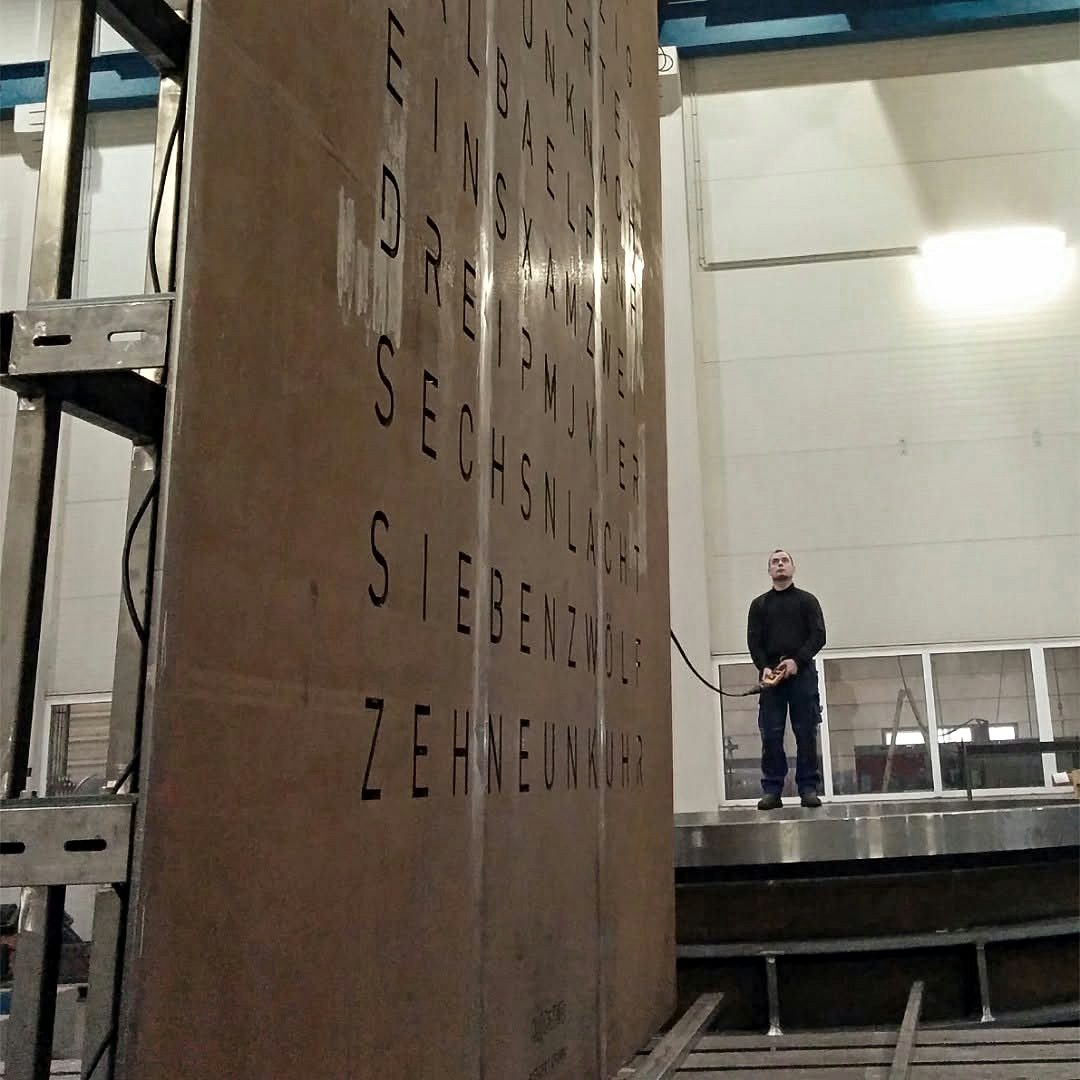
For the Gamundia building at the Remspark, the design was scaled up to 5.20 × 5.20 metres: around 27 square metres mounted vertically on a facade. Bock fabricated the steel front panel for this version.
At this scale, fabricating the panel becomes a structural task. It must remain flat, carry its own weight, withstand wind loads and accommodate thermal expansion. The visible lettering depends on work that is less visible: controlling the plate geometry and making it fit the building’s mounting points.
Dimensions, weight and installation details
The key data of the component – from our 2014 news article and from the press release of the city of Schwäbisch Gmünd of 14 March 2014:
| Feature | Value |
|---|---|
| Dimensions | 5.20 × 5.20 m (around 27 m²) |
| Total weight | over 4,000 kg (city press release, 14 March 2014) |
| Front panel | 2,600 kg Corten steel with cut-out letters |
| Base frame | Stainless steel |
| Lighting | 110 LED lights behind the letter matrix |
| Mounting | Rails set into the wall during construction of the building |
| Location | Gamundia building at the Remspark, Schwäbisch Gmünd |
| Commissioning | March 2014, before the opening of the Landesgartenschau (state garden show) |
The front panel alone weighs 2,600 kg – and hangs vertically on a wall. That is why the order was not decided by clock technology but by the question of who can deliver 2.6 tonnes of plate flat and dimensionally accurate.
What changes at this size
Scaling up the clock brought four connected fabrication challenges:
- Flatness over 27 square metres. A facade panel that bulges casts shadows on the wall and distorts the lettering. Flatness over this area is not a matter of cutting alone but of the stresses in the plate – and these arise with every thermal cut.
- The letter matrix weakens the panel. Every cut-out letter removes material. What is meant to be legible as lettering is, structurally speaking, a hole pattern – the remaining webs carry the panel.
- Handling and transport. 2.6 tonnes of plate cannot be turned by hand. Every work step – raising, turning, loading – needs a crane, lifting gear and space.
- The interface with the wall. The mounting rails were already in place in the building shell. The component had to fit a geometry that was finished before it and could no longer be corrected.
The project brought together the same concerns as other large one-off fabrications: geometry, material behaviour, handling and assembly. Having cutting, welded fabrication and surface treatment in one plant helps coordinate those stages.
Corten steel: a material that rusts on purpose
The front panel is made of Corten steel – a weathering structural steel that deliberately forms a layer of rust. This patina does not stop at some arbitrary colour: it densifies into a firmly adhering surface layer that protects the steel underneath from further loss of material. The material therefore protects itself through exactly the process that is prevented with paint on other steels.
The changing surface also belongs to the design. As the patina develops and darkens, the clock’s appearance changes with the years: a material expression of the time shown by its illuminated letters.
Corten steel is one of the materials we process regularly – alongside structural steels such as S235 and S355, fine-grain structural steels, wear-resistant steels and stainless steels. We mainly process European quality steel, on request with inspection certificate 3.1 to EN 10204.
Commissioning for the 2014 state garden show
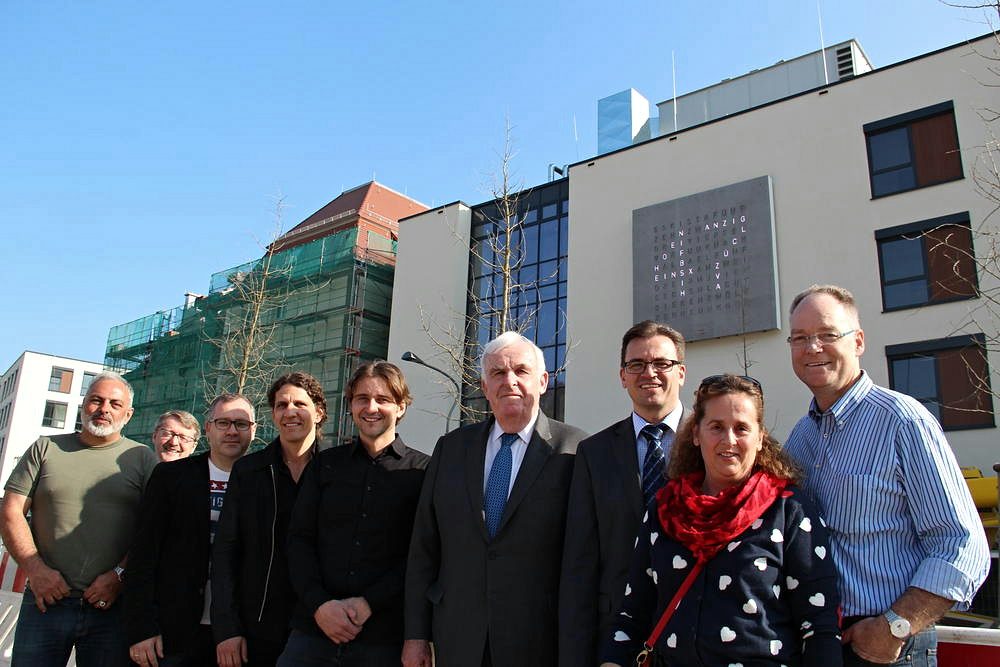
The clock was inaugurated in March 2014, in time for the opening of the Landesgartenschau in Schwäbisch Gmünd. Building owner Berndt-Ulrich Scholz, Mayor Dr Joachim Bläse, Landesgartenschau managing director Manfred Maile and Marco Biegert and Andreas Funk put it into operation together.
When it was put into operation in March 2014, the clock first showed the countdown to the Landesgartenschau. Since 30 April 2014 it has shown the time in words. It hangs on the Gamundia building near the railway station. The matrix changes in a five-minute rhythm; the minutes in between are indicated by four illuminated corner dots. Light sensors control the brightness: easy to read during the day, dimmed at night so that the station forecourt is not flooded with light.
Looking back at the 2014 project
This article was originally published in April 2014 on our old website. For the relaunch we revised it, checked the details against the sources of the time and added today's perspective. The photos of the finished clock and from our workshop are by Biegert & Funk (QLOCKTWO), the photo of the commissioning is from the press release of the city of Schwäbisch Gmünd of 14 March 2014.
The word clock shows how a design commission can become a large-scale fabrication project. Its purpose differs from a machine frame or a crane component, but the workshop questions are familiar: how to handle a large plate, control its geometry and deliver it ready to fit.
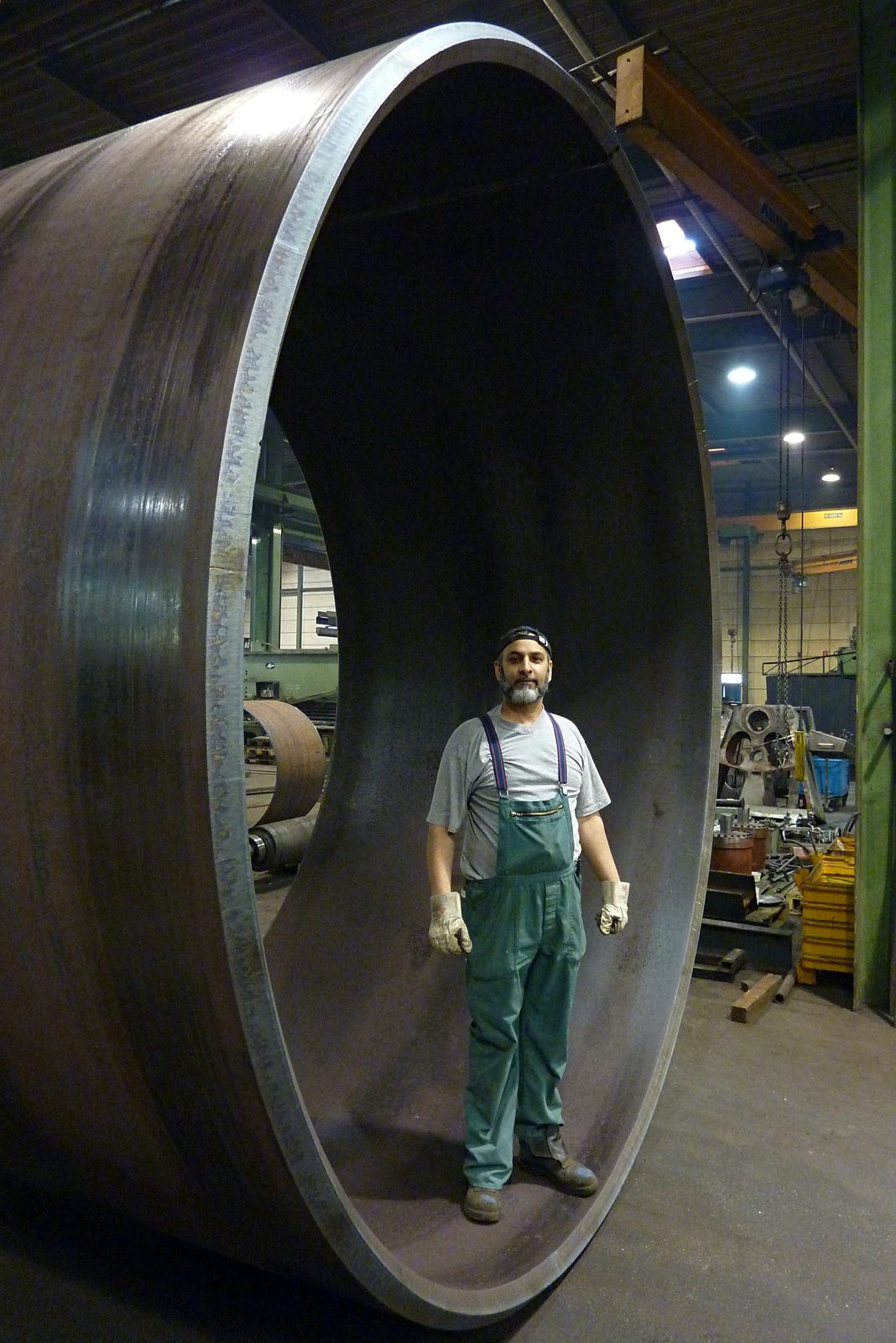
Today we answer this question with the same process chain under one roof: flame cutting up to 200 mm, forming, welded structures to DIN EN 1090-2 EXC3, machining up to 26 m component length and unit weights up to 50 t, plus shot blasting and painting. And occasionally a clock, too.
Frequently asked questions about large-format Corten steel components
Can we have large-format components made from Corten steel?
Yes. Corten steel is one of the materials we process regularly – from cutting and welded construction to machining. Early coordination makes sense, because the patina only forms on the installed component and run-off staining on adjacent components can then be allowed for in the planning.
How large and how heavy can a component be at your company?
The limits are set by the machines and the crane, not by the component: we flame-cut material thicknesses up to 200 mm, machine component lengths up to 26 m and unit weights up to 50 t on around 14,000 m² of production space. For the word clock, an edge length of 5.20 metres and 2.6 tonnes of plate were therefore a format the hall handles as a matter of routine.
Does such a large plate stay flat, or does it distort?
Every thermal cut introduces stresses into the component, and the larger the area, the more visible they become. We counter this with the cutting sequence and heat control – and, where it matters, with vibration stress relief or flame straightening before the functional surfaces are produced.
Do you also manufacture one-off pieces for architecture and art projects?
Yes, with no minimum order quantities. From a single part to a small series, the process is the same as for an industrial order: check feasibility, define material and tolerances, manufacture. For objects in public spaces, structural analysis and the mounting interface come in early – for the word clock, the rails were already in the building shell.
How does an enquiry for a special component work?
A drawing or STEP file, material and quantity are enough to get started. If there is no drawing yet – which is the rule for objects from the design world – dimensions, preferred material and installation situation are sufficient: our production planning department checks feasibility and delivery date and gets back to you with a concrete quote.
Sources and context
- Dimensions, weight stated as over four tonnes, commissioning as a countdown and time display from 30 April 2014; the world-record claim is attributed to Biegert & Funk. Die Vier-Tonnen-Uhr tickt ("The four-tonne clock is ticking", 14 March 2014)